Buying Saffron Wholesale: A Supplier Checklist for Restaurants, Retailers and Importers
How to vet a wholesale Kashmiri saffron supplier: the lab report to demand, grade and moisture checks, origin proof, sample testing, price sanity.
By Kashmiri Treasures · October 31, 2026 · 6 min read
Buying saffron by the hundred grams or the kilogram is where the fraud in this trade concentrates, because the sums are large, the product is hard to judge by eye, and a wholesale sack can hide a great deal. The defence is procedural rather than clever: insist on a lab report for the exact lot, test a sample yourself, check origin claims against documents, and sanity-check the price against the current market. A supplier who passes all four is probably sound. One who fails the first is not worth the rest.
This checklist is written for restaurant and hotel buyers, sweet shops, retailers repacking saffron under their own label, and importers. It is also, deliberately, the standard we hold ourselves to on our own bulk orders page.
1. The lab report, and the right lab report
An ISO 3632 report is the one document that turns a claim into a measurement. It gives colouring strength (crocin), bitterness (picrocrocin), aroma (safranal), moisture and floral waste, and it should also screen for synthetic dyes. Our quality and testing page explains each figure.
What to check on the report:
- It is for your lot. A report from a different batch, or last year, or a brand-wide typical number, proves nothing about the sack in front of you. Lot code on the report, lot code on the pack.
- The lab is accredited. In India, look for NABL accreditation and a ULR number that can be checked with the lab. Elsewhere, ISO 17025 accreditation. A report on a seller’s own letterhead is marketing.
- The date is recent. Within weeks of harvest or of the sale, not years.
- Category I numbers. Colouring strength above 200, and for Kashmiri Mongra realistically 230 or more. Moisture at or under 12 percent. Floral waste under 0.5 percent for stigma-only grades.
- Artificial colourants: not detected.
If the supplier cannot or will not provide this, or offers to test only orders above a kilogram at your cost, you have learned what you needed to know.
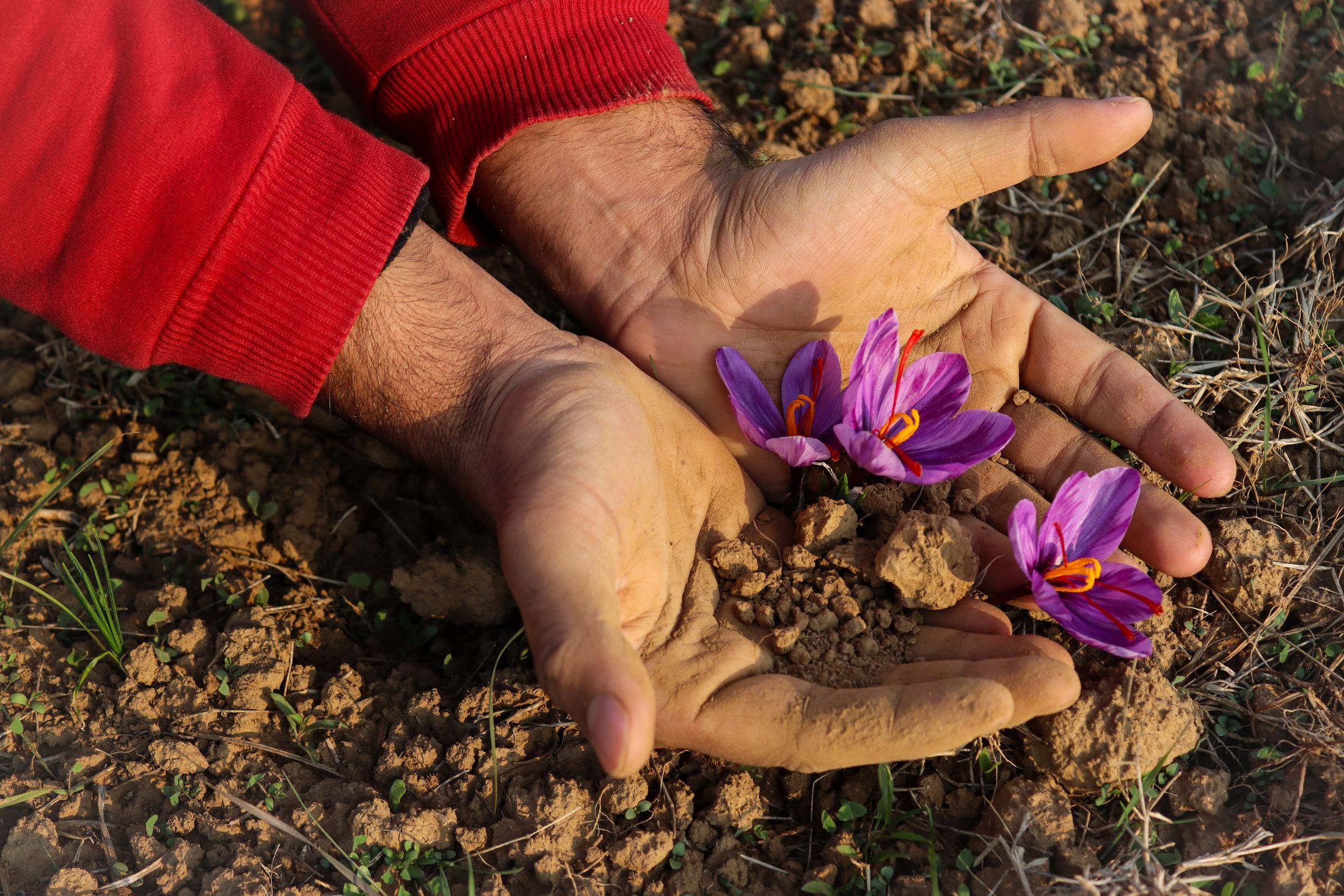
2. Grade, in plain words
Saffron grades have local names that are easily blurred. Insist on the plain description.
- Stigma only, style removed. Kashmiri Mongra, Persian super negin and negin, Spanish coupe. The strongest grade by weight.
- Whole stigma with style attached. Kashmiri Lacha, Persian pushal, Spanish mancha. Genuine saffron, weaker by weight, cheaper, and sometimes sold as the grade above.
- Broken, bunched or powdered. Lower grades and the home of most fraud.
Ask which one you are being quoted, and look at the sample: red along the whole length with trumpet tips means stigma only; yellow or white bases mean style. Saffron grades explained has photographs and the ISO mapping.
3. The sample
Ask for 2 to 5 g from the exact lot, not from a display jar. Then:
- Water test. Five threads in warm water. Slow, clear yellow over 15 to 20 minutes, threads still red. Instant orange or threads going pale means dye.
- Smell. Honey, hay, a leathery sweetness. Faint means old; chemical means treated.
- Taste. Slightly bitter, floral. Sweet means it has been dipped in honey or sugar syrup to add weight.
- Rub. A thread rubbed on damp white paper leaves a yellow-orange streak; red means dye.
- Look under a lens. Uniform red, trumpet-shaped tips, no fibres, no sticks, no coconut or corn silk.
For anything above a few hundred grams, split the sample and send part to an accredited lab for your own ISO 3632 report. It costs a small fraction of the order and removes all argument. How to spot fake saffron covers the tests in detail.
4. Origin and the GI
If you are paying for Kashmiri saffron, the price premium over Iranian is large, and so is the incentive to relabel. Kashmir Saffron is a registered Geographical Indication, No. 635, and only producers and traders authorised under it may use the name and logo. Ask for the supplier’s GI authorised-user status or that of the grower cooperative they buy from, the village and grower names, and the harvest date. The India International Kashmir Saffron Trading Centre at Pampore grades and certifies saffron sold through it. How to verify GI-tagged Kashmiri saffron and the GI tag explained go into the paperwork.
Remember that a Category I lab report does not prove Kashmiri origin; excellent Iranian saffron also tests Category I. Origin is a chain of custody.
5. Price sanity
Know the market before you ask for a quote. Pampore wholesale for stigma-only Mongra has moved between roughly ₹2 and ₹3.5 lakh per kilogram in recent seasons, with records after the poor harvests of 2024 and 2025; Iranian super negin trades lower. Saffron price per gram tracks both. A fair wholesale quote for genuine Kashmiri Mongra sits at or above the Pampore range plus the seller’s testing, packing and margin. Quotes are typically valid for a short period because the market moves; a seller who offers a fixed price for a whole season is taking the risk for you and should say so.
6. Moisture, weight and packaging
Moisture is money. Saffron at 15 percent moisture weighs more than the same saffron at 10 percent, and it moulds. The ISO limit is 12 percent; the report tells you. Weigh what arrives against what you paid for, on a calibrated scale, net of packaging.
Ask how it will be packed: sealed foil pouches or tins, in the dark, with lot codes on each pack. Avoid bulk saffron in clear jars or open bags. How to store saffron applies at any scale.
7. Paperwork for import
For international orders expect a commercial invoice, a packing list, the lab report, and on request a certificate of origin. Dried saffron is a spice, not a live plant, and needs no phytosanitary certificate in most destinations; the US requires FDA prior notice, which a competent exporter files. Check your country’s import duty and food labelling rules before you order; retail-ready labelling in the destination language may be needed if you sell on.
8. The relationship
The best wholesale saffron comes from suppliers who can tell you which field it grew in, and who will still be there next season. Ask how long they have bought from the same growers, whether they can show you the harvest, and what happens if a lot fails your test on arrival. A supplier confident in their product will offer to take it back.
The checklist
- ISO 3632 report for this lot, from an accredited lab, with a verifiable report number and a dye screen.
- Grade stated plainly: stigma only, or with style.
- A sample from the same lot, tested by you and, for large orders, by a lab.
- Origin evidence: GI authorisation, grower and village, harvest date.
- Price consistent with the current Pampore or Iranian market.
- Moisture under 12 percent; net weight checked on arrival.
- Sealed, dark, lot-coded packaging.
- Invoice, packing list, certificate of origin; FDA prior notice for the US.
- A returns clause if the lot fails your test.
We supply tins to 100 g from the saffron page, and quote above that through the bulk orders page, with the lot report attached to every quote. Saffron for restaurants covers the kitchen side.
Read next: Saffron for restaurants: a chef’s buying and cooking guide and Saffron grades and ISO 3632 explained.
Questions people ask
What should I ask a wholesale saffron supplier for?
An ISO 3632 lab report for the specific lot you are buying, from an accredited laboratory, with a report number you can verify; the harvest date; the grade in plain terms, stigma-only or with style; a sample from the same lot before you commit; proof of origin such as GI authorisation for Kashmiri saffron; and a price consistent with the current wholesale market. A supplier who cannot supply the first item is not a supplier.
What is the wholesale price of Kashmiri saffron?
It moves with the harvest. At the Pampore trading centre, stigma-only Mongra has traded between roughly ₹2 lakh and ₹3.5 lakh per kilogram in recent seasons, about $2,400 to $4,200, with record highs after the poor 2024 and 2025 harvests. Iranian super negin wholesales for less. Quotes far below the current Pampore range are not Kashmiri Mongra.
What is the minimum order for wholesale saffron?
It varies by seller. Ours is 100 g; many exporters start at 500 g or 1 kg. Below 100 g, retail tins are usually better value once packaging and testing are included.
How do I test wholesale saffron before buying?
Ask for a 2 to 5 g sample from the exact lot. Do the water test, smell and taste it, and check the threads for trimmed style and uniform colour. For anything above a few hundred grams, send part of the sample to an accredited lab for your own ISO 3632 report; it costs little against the order value and settles every question.
Mongra or Lacha for bulk use?
Mongra, the stigma-only grade, for anything where colour and aroma per gram matter, which is most kitchens and all retail repacking. Lacha, with style attached, is cheaper per gram but weaker, so the saving per dish is smaller than the price suggests, and it cannot honestly be sold on as premium.
Written by the Kashmiri Treasures team in Srinagar. We buy at the field in Pampore, test every lot to ISO 3632, and print the result on the vial. See who we are or verify a lot.