Saffron Grades Explained: Mongra vs Lacha, ISO 3632 and How to Read a Lab Report
Mongra vs Lacha saffron, Super Negin vs Sargol, Coupe vs Mancha, and the ISO 3632 numbers behind them. A plain guide to reading a saffron lab report.
By Kashmiri Treasures · October 7, 2026 · 10 min read
Saffron grading confuses people because at least four grading languages run side by side. Kashmir sells Mongra, Lacha and Guchhi. Iran sells Super Negin, Negin, Sargol and Pushal. Spain sells Coupe and Mancha. And underneath all of them sits ISO 3632, the laboratory standard that measures what the saffron actually does in water, in numbers. The short version: Mongra, Super Negin and Coupe all mean “red stigma only, no yellow style,” and ISO 3632 Category I means the lab confirmed the threads are strong in colour, taste and aroma.
The trade names tell you how the flower was processed. The ISO numbers tell you how the dried spice performs. A serious seller should be able to give you both, and the second matters more than the first, because a trade name is a word on a label while a crocin reading is a measurement you can verify.
We buy Mongra at the field in Pampore and send every lot for an ISO 3632 test before it is bottled, so we read a lot of these reports. This guide explains each grading system, lays out the ISO 3632 thresholds in one table, and ends with a thirty-second checklist you can use on any report from any seller.
Why saffron grades exist at all
Every saffron thread is one of the three stigmas of a Crocus sativus flower. The stigma is dark red and carries nearly all the crocin, picrocrocin and safranal, the compounds responsible for colour, bitterness and aroma. The stigmas join the flower at a pale yellow stalk called the style, which carries almost none of those compounds.
Grading, in every country, comes down to one question: how much of the pale style is left in the jar? Style adds weight and length. It adds very little colour or flavour. So a grade with the style removed costs more per gram and gives more per gram, and a grade with style attached costs less and gives less.
Everything else, thread length, thread thickness, uniformity, whether the threads are loose or bundled, is a matter of tradition and appearance rather than performance.
Kashmiri saffron grades: Mongra, Lacha and Guchhi
Kashmir’s Geographical Indication, GI No. 635, protects three named grades grown within the registered tehsils of Pulwama (including Pampore), Budgam, Srinagar and Kishtwar at 1,600 to 1,800 metres on Karewa soil.
Mongra (stigma only)
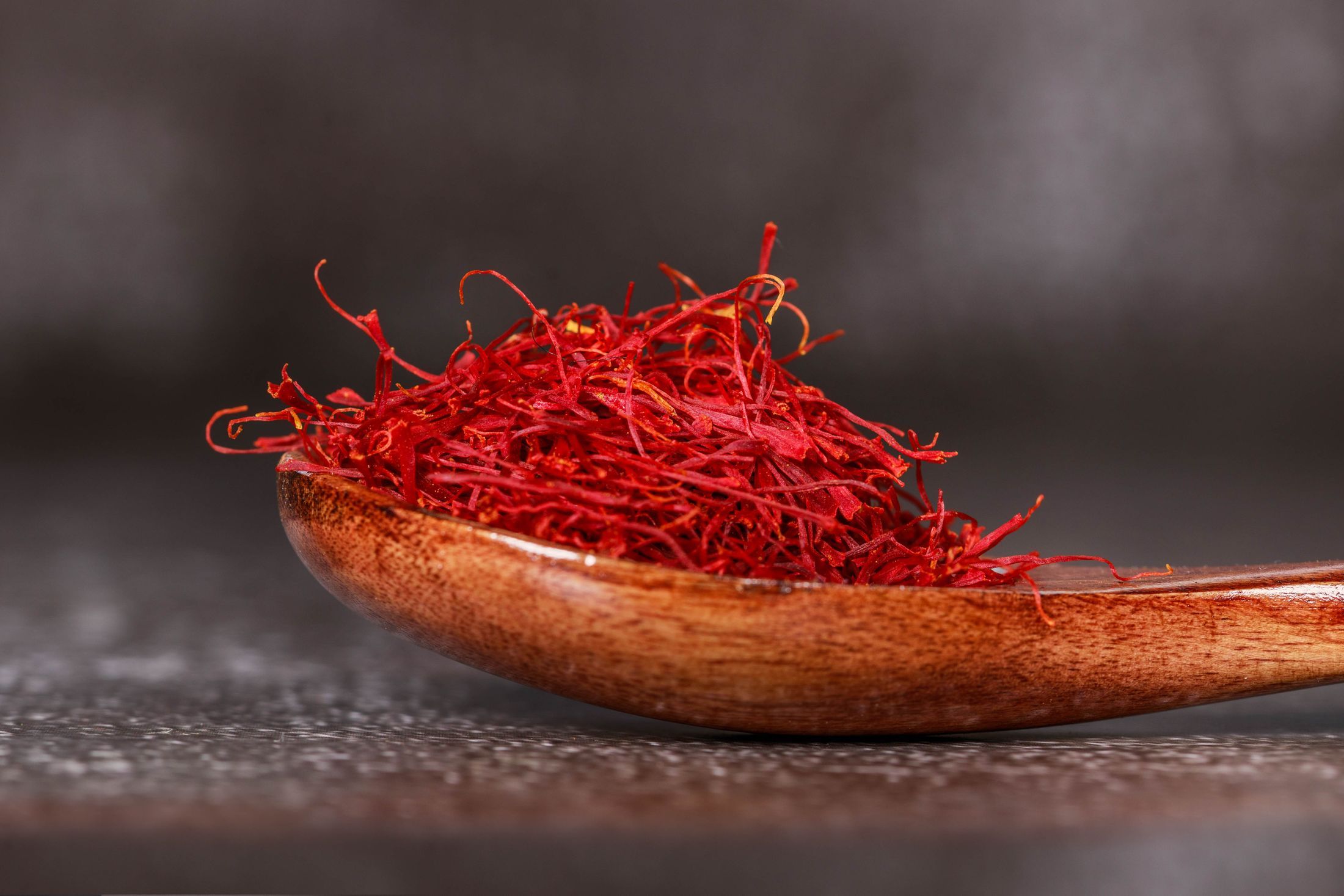
Mongra is the premium grade. After the dawn harvest, pickers separate each flower by hand, then snip the three dark red stigma tips away from the style. What goes in the jar is stigma and nothing else. Mongra threads are short, thick, curved and deep crimson, with a trumpet-shaped tip. Because every milligram is stigma, Mongra delivers the highest colouring strength per gram of the three Kashmiri grades. This is the grade we sell, and the only grade we have ever bottled.
Lacha (stigma with part of the style)
Lacha keeps the three stigmas joined to a short length of the yellow style, the way they come off the flower. You can see pale yellow or white tails at the base of the red. A gram of Lacha therefore contains less red material than a gram of Mongra, and gives noticeably less colour. Lacha is honest saffron, and a good choice for a tighter budget, when it is sold as Lacha. The problem across the market is Lacha sold as Mongra at Mongra prices.
Guchhi (whole dried bundles)
Guchhi, also spelled Gucchi, is the whole dried stigma-and-style bundle, often tied, as it came from the flower. It is mostly used locally and rarely exported. It is the least processed and the cheapest per gram, and it carries the most style.
The practical way to tell Mongra from Lacha: tip a few threads onto white paper. Mongra shows red from base to tip. Lacha shows yellow at the base. If you see a lot of yellow in a jar sold as Mongra, you have been short-changed. Our guide to spotting fake saffron covers the other things to look for.
Persian saffron grades: Super Negin, Negin, Sargol and Pushal
Iran grows about 90 percent of the world’s saffron, according to the Alibaba spice price guide, so Persian grade names are the ones most international buyers meet first. The logic is identical to Kashmir’s, with one more dimension: thread length.
- Super Negin: the longest, thickest, all-red stigmas, trimmed so that no style remains, and sorted for uniformity. This is the Persian equivalent of Mongra and the grade most premium Persian and Afghan brands sell.
- Negin: all-red stigma, slightly shorter or less uniform than Super Negin, sometimes with a trace of orange at the base.
- Sargol: the word means “top of the flower.” Red stigma tips cut away from the style, usually shorter and more broken than Negin because they are cut rather than kept whole. Very high colouring strength per gram; less visually impressive.
- Pushal: stigma with part of the yellow style attached. The Persian counterpart of Lacha.
- Bunch (Dasteh): whole threads with style, tied in bundles. The counterpart of Guchhi.
So when someone asks about Super Negin vs Mongra, the honest answer is that both describe style-free stigma from the top of the grading ladder. The differences you see are regional: Super Negin threads are longer and straighter; Mongra threads are shorter, thicker and more curled. Which is stronger in the pan is a question for the lab report of the specific lot, not for the name on the tin. We compare origins in detail in Kashmiri vs Persian vs Spanish saffron.
Spanish saffron grades: Coupe and Mancha
Spain uses a shorter list, and the names overlap confusingly with its protected origin.
- Coupe: all-red stigma with the style cut away, the top Spanish grade and the equivalent of Mongra or Super Negin.
- Mancha: traditionally, red stigma with some yellow style attached, a step below Coupe. Note that “Mancha” is also the name of the region, and Azafrán de La Mancha is a protected designation of origin (D.O.P.) for saffron grown there, so a label can say “La Mancha” to mean the place, the grade, or both. Read carefully.
- Rio and Sierra: older trade names for lower grades with progressively more style; rarely seen on retail packs now.
A lot of saffron labelled “Spanish” at supermarket prices is bulk Iranian saffron packed in Spain, which is legal when the label describes it correctly. The D.O.P. seal is the only guarantee of Spanish-grown origin.
ISO 3632 saffron categories: what the lab measures
ISO 3632 is the international standard for saffron, and it is the one grading system that does not depend on who is describing the threads. Part 1 sets the specification; Part 2 sets the test methods. A lab grinds a sample, dissolves it in water, and reads how strongly the solution absorbs ultraviolet and visible light at three wavelengths using a spectrophotometer. Each wavelength corresponds to one compound.
| Reading | Compound | What it measures | Wavelength | Category I | Category II | Category III |
|---|---|---|---|---|---|---|
| Colouring strength | Crocin | Colour the saffron gives | 440 nm | 200 or higher | 170 or higher | 120 or higher |
| Bitterness | Picrocrocin | Taste strength | 257 nm | 70 or higher | 55 or higher | 40 or higher |
| Aroma | Safranal | Fragrance | 330 nm | 20 to 50 | 20 to 50 | 20 to 50 |
The report also carries physical and purity checks:
- Moisture and volatile matter: 12 percent or below. Wet saffron weighs more, keeps worse and may have been sold wet on purpose.
- Floral waste: style, stamen and other flower parts. Category I allows no more than 0.5 percent; higher categories permit more.
- Extraneous matter: anything that is not from the flower, such as dust, fibre or sand.
- Artificial colourants: synthetic dyes such as tartrazine and Sudan dyes, detected by HPLC. The only acceptable result is “not detected.”
A few things people get wrong about ISO 3632:
Crocin matters most for cooking. Crocin is literally the colour you get in rice, milk or broth. A lot at 250 will colour roughly a quarter more than a lot at 200, gram for gram, so a higher crocin number means you use fewer threads. Sellers of Kashmiri Mongra report readings of 230 to 270 for good Pampore lots, against the Category I floor of 200. Those are seller-reported figures, including our own, which is why we print the number for each lot rather than quoting a range.
Safranal is a band, not a floor. A safranal reading above 50 is unusual and can indicate overheated drying or an old sample where other compounds have broken down into safranal; a reading below 20 means weak aroma. Fresh, well-dried saffron sits inside the band.
Category I does not mean a particular origin. A Persian Super Negin, a Spanish Coupe and a Kashmiri Mongra can all test Category I. The category describes strength, not geography. Geography is what the GI and D.O.P. systems protect, and we explain what Kashmir’s GI covers in our Kashmir saffron GI tag guide.
Numbers fade. Crocin and safranal decline with light, heat, air and time. A report dated three years ago describes saffron that no longer exists. That is why harvest date and report date both belong on the label.
How Kashmiri Treasures grades and tests
Our practice is simple and we would rather describe it once than repeat it on every page. We buy Mongra directly from named growers in Pampore during the October harvest. Each lot is dried, sorted and sent to an accredited laboratory for an ISO 3632 panel before anything is bottled. The lab report, with its ULR number, goes on our verify page under the lot code, and that lot code, the crocin number, the harvest date and the grower’s name are printed on every vial.
If you send a vial to an independent accredited lab and it does not test Category I, we refund double what you paid. We have not had to yet, and we would like to keep it that way, which is why the grading happens before the sale rather than after a complaint. You can read how the harvest and sorting work in How Saffron Is Harvested in Pampore and meet the growers on our story page.
How to read a saffron lab report in 30 seconds
Here is the checklist we use ourselves. Run it on any report, from any seller, including ours.
- Batch code. Find the lot or batch number on the report and check that it matches the number on the pack. No batch code, or a mismatch, and the report tells you nothing about what is in your hand.
- Laboratory and accreditation. The report should name the lab and show its accreditation. In India that means NABL, and the report carries a ULR (Unique Laboratory Report) number you can check on the Quality Council of India portal. Elsewhere, look for ISO/IEC 17025 accreditation.
- The three numbers. Crocin 200 or higher, picrocrocin 70 or higher, safranal between 20 and 50. All three together are Category I. One miss drops the lot a category, whatever the label says.
- Purity lines. Moisture 12 percent or below. Floral waste 0.5 percent or below for Category I. Artificial colourants: not detected.
- Dates. Harvest date on the pack, report date on the paper, and the two within a year of each other. Saffron tested long ago is saffron you cannot judge today.
Red flags that should end the conversation: a “certificate” with no numbers, a report with no batch code, a pixelated or clearly edited PDF, a lab whose accreditation you cannot find, or a seller who says the report is “available on request” and then never sends it.
Which grade should you actually buy?
For most home cooks, wellness buyers and gift buyers, the answer is the red-only grade of whichever origin you prefer, backed by a Category I report. You use fewer threads, so the higher price per gram is partly offset, and you avoid paying saffron prices for yellow style.
Lacha, Pushal or Mancha-grade saffron makes sense when you cook with saffron in quantity, the label is honest and the price reflects it. Guchhi and bunch grades are for people who want to trim at home.
Powder of any grade is the one form we would avoid unless you grind it yourself, because grinding destroys every visual check and makes the spice easy to cut. Whole threads, a batch code and a report are the combination that protects you. Current prices by origin and pack size are in our saffron price per gram guide, and the product itself, with this season’s lot number and crocin reading, is on our saffron page.
Read next
If you want to see how grades translate into real differences between origins, read Kashmiri vs Persian vs Spanish Saffron: Colour, Aroma, Price and Which to Buy. If you have a jar in front of you and want to check it before you cook, go to How to Spot Fake Saffron: 9 Tests You Can Do at Home.
Questions people ask
What does Mongra saffron mean?
Mongra is the Kashmiri trade name for the top grade of Kashmir saffron: the dark red stigma tips only, snipped from the pale yellow style by hand so that every thread is pure colour and aroma. It is one of three grades protected under Kashmir's GI registration, No. 635, alongside Lacha and Guchhi. Because nothing but stigma goes into the jar, Mongra gives the most colour per gram and is the grade we sell.
What is the difference between Mongra and Lacha saffron?
Both come from the same flower. Mongra is stigma only, with the yellow style removed. Lacha keeps the stigma attached to part of the style, so each gram contains some pale material that adds weight but almost no colour or aroma. Lacha is honest saffron when labelled as Lacha and priced lower. The problem is Lacha sold as Mongra, which a quick look for yellow tails and a crocin reading will reveal.
What does ISO 3632 Category I mean?
ISO 3632 is the international standard for saffron. A lab measures the dried spice with a spectrophotometer and reports three values: crocin for colour, picrocrocin for bitterness and safranal for aroma. Category I, the highest, requires crocin of 200 or more, picrocrocin of 70 or more and safranal between 20 and 50, with moisture at or below 12 percent. The category says how strong the saffron is, not where it came from.
Is Super Negin better than Mongra?
They are the top grades of two different traditions, Persian and Kashmiri, and both describe all-red, style-free stigma. Super Negin threads are long, straight and uniform; Mongra threads are shorter, thicker and more curved. Which is better in the pan depends on the lab numbers of the specific lot, not the name. Sellers of Kashmiri Mongra report crocin readings of 230 to 270, but you should ask for the report for the batch you are buying.
How do I read a saffron lab report quickly?
Check five things in order. The batch or lot code on the report matches the pack. The lab is accredited, with a NABL ULR number if the test was done in India. Crocin is 200 or higher, picrocrocin 70 or higher and safranal between 20 and 50, which together mean Category I. Artificial colourants read not detected. The report date is within about a year of the harvest, because colour and aroma fade with time.
Written by the Kashmiri Treasures team in Srinagar. We buy at the field in Pampore, test every lot to ISO 3632, and print the result on the vial. See who we are or verify a lot.