Why Is Saffron So Expensive? 150 Flowers a Gram, a Three-Week Harvest, and a Plant That Cannot Set Seed
Why saffron is the most expensive spice: 150 flowers a gram, a dawn hand harvest, a sterile plant grown from corms, tiny yields per hectare, and why it is cheap per dish.
By Kashmiri Treasures · October 31, 2026 · 5 min read
Saffron costs what it does because a single flower yields three threads, it takes about 150 flowers to make a gram, every flower is picked by hand at dawn in a three-week window once a year, and the plant cannot be grown from seed or harvested by machine. Nothing about that has changed in three thousand years, and nothing is likely to. The world’s entire supply would fit in a few shipping containers.
That is the short answer. The long answer is a tour of a strange plant, the arithmetic of hand labour, the economics of a crop that grows well in only a few places, and a last section on why, per plate, saffron is one of the cheaper things you will cook with.
The flower
Crocus sativus is a small autumn-flowering crocus with lilac petals and, at its centre, a single style that divides into three deep red stigmas two to three centimetres long. Those three stigmas are saffron. Everything else, the petals, the yellow stamens, the pale style that joins the stigmas to the flower, is either waste or a cheaper grade.
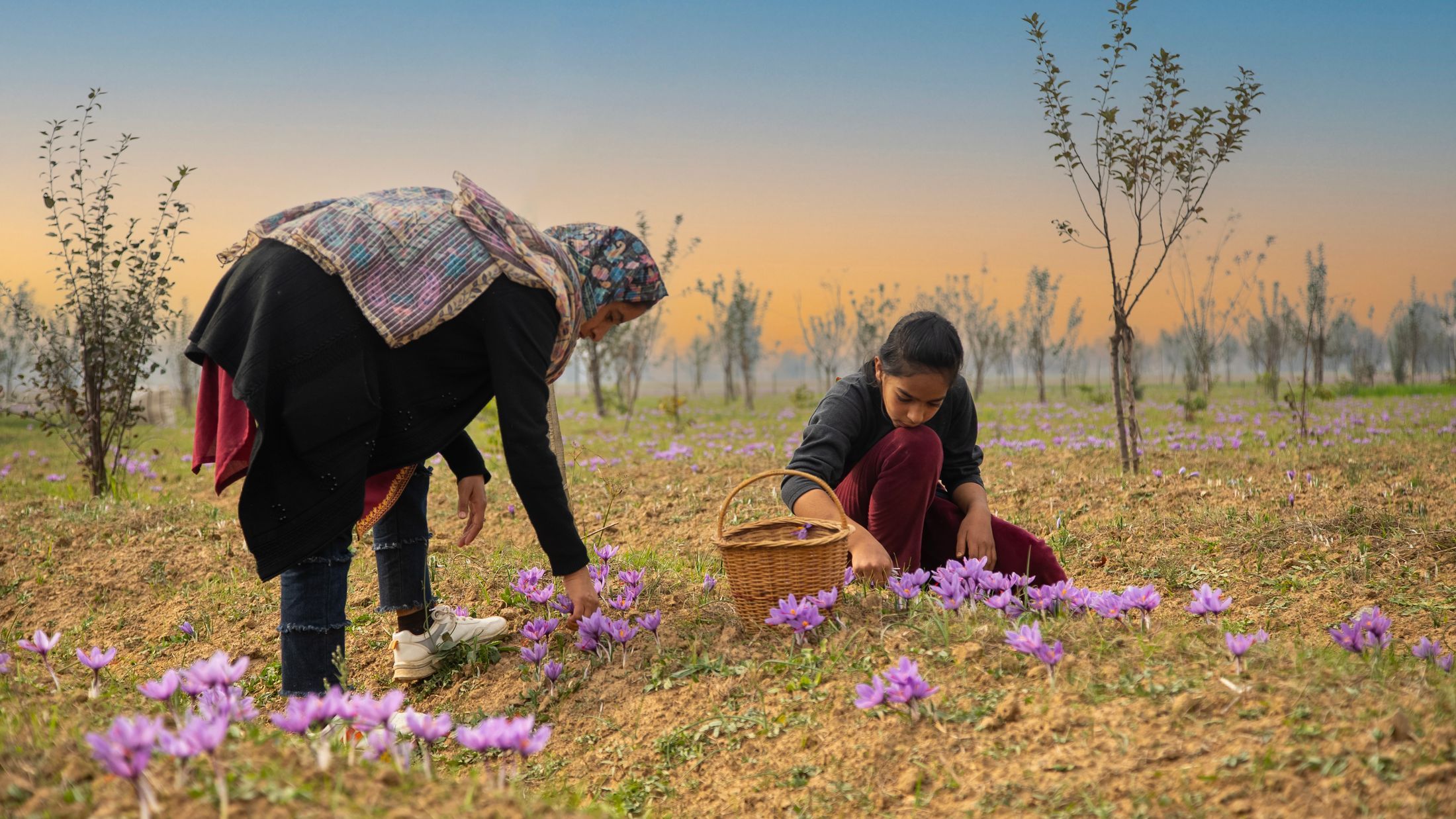
Each corm produces one to a few flowers a season. Each flower opens once, lasts a day or two, and is picked the morning it opens, because sun and rain damage the stigmas and because the flower wilts quickly. In Pampore, picking begins at first light and the fields are mostly bare by midday.
Dried stigmas weigh very little. A single stigma dries to about 2 mg, so three from a flower give roughly 6 to 7 mg. One gram of finished Mongra, stigma only with the style trimmed away, needs around 150 flowers. A kilogram needs about 150,000.
The labour
Picking is the first job. A practised picker gathers a few thousand flowers in a morning, which is a few tens of grams of finished saffron. Then comes the part that cannot be rushed: the family sits that afternoon and separates the three stigmas from each flower by hand, pinching off the pale style so only the red tip remains. This is what turns a basket of flowers into Mongra, and it takes as long as the picking did.
Estimates vary, but somewhere around 40 hours of labour go into a kilogram of saffron at the picking stage alone, and a similar amount into separation. None of it has been mechanised. A machine that could find a crocus in the field, pick it without bruising, and tweeze three threads from its centre does not exist, and the economics of a crop this small have never justified inventing one.
Drying is the last step and the one that makes or breaks quality. Stigmas are spread thin on cloth or sieves and dried in warm shade, or over gentle heat in Spain and Iran, losing about four fifths of their weight. Too slow and they mould; too hot and the aroma goes. How saffron is harvested in Pampore follows the whole process.
The plant that cannot reproduce
Saffron crocus is a triploid: it has three sets of chromosomes instead of two, and the result is sterility. It sets no viable seed. Every saffron plant on earth has been propagated by dividing corms, the underground bulbs, by hand, for at least three and a half thousand years. Every plant is, in effect, a cutting of the first ones.
This matters for price in two ways. There is no breeding programme, because there is nothing to breed; the plant has not been improved for yield, disease resistance or size the way wheat or apples have. And expanding production means digging up, dividing and replanting corms by hand, a slow process that takes years to reach full yield. When a harvest fails, as Kashmir’s did in 2024 and 2025 after unseasonal rain, there is no quick way to make up the shortfall.
Land, climate and place
Saffron grows well in a narrow band of conditions: hot dry summers for dormancy, a cool wet autumn to trigger flowering, cold winters, well-drained soil that does not waterlog the corms, and altitude or latitude that gives cold nights during bloom. Khorasan, Kashmir, La Mancha, Kozani in Greece, Abruzzo and Sardinia, Taliouine in Morocco: the list of places that produce saffron of quality is short and has barely changed in centuries.
In Kashmir the growing area is shrinking. The Karewa plateaus around Pampore sit beside a growing city and a national highway, water tables have fallen, and young people leave for other work. The 2020 Geographical Indication was partly an attempt to protect the crop by protecting its price. The Kashmir saffron GI tag explained covers what that means.
Demand
Against that small, fragile supply sits demand from every cuisine that uses saffron, from the supplement market that has grown around the clinical research of the last two decades, from cosmetics, and from a global diaspora for whom kesar is not optional at a wedding or a festival. Prices at the Pampore trading centre reached records in 2025 and 2026 as poor harvests met rising export demand. Saffron price per gram tracks what that means at retail.
Why cheap saffron is a warning
Everything above sets a floor under the price of real saffron. Growers in Pampore need several hundred rupees a gram to make the crop worth the labour; Iranian saffron at wholesale is cheaper but not by an order of magnitude. Retail Kashmiri Mongra at $18 to $22 a gram and Persian super negin at $5 to $10 are both consistent with the costs. Saffron offered at $2 a gram is not: it is Lacha sold as Mongra, old stock, cut with style, or not saffron at all. How to spot fake saffron and kashmiri vs Persian vs Spanish saffron help with the judgement.
Expensive per gram, cheap per plate
The price per gram frightens people away from a spice that is, per serving, among the cheapest in the kitchen. A dish for four uses 15 to 20 threads, about 40 mg. At $20 a gram that is 80 cents for the whole dish, 20 cents a plate. A cup of saffron milk is about 20 cents. A gram makes 20 to 30 dishes and keeps for two years. Fresh basil costs more per dinner.
So the honest framing is this: saffron is expensive because it is almost impossibly labour-intensive to produce and grows in only a few places, and it is cheap to use because a little does so much. Both are true, and the second is the reason to buy the good kind. The current lot, with its grower and lab report, is on the saffron page.
Read next: How saffron is harvested in Pampore and The history of saffron.
Questions people ask
Why is saffron the most expensive spice in the world?
Because each saffron crocus flower yields only three usable stigmas, it takes about 150 flowers to make one gram of dried saffron, and every flower is picked by hand at dawn during a bloom that lasts about three weeks a year. The plant is a sterile triploid that cannot be grown from seed, yields are a few kilograms per hectare, and nothing in the process has been mechanised. Supply is small, labour is enormous, and demand is global.
How many saffron flowers make 1 gram?
About 150 flowers for a gram of dried stigma-only saffron, or roughly 450 stigmas. Figures from 130 to 170 are quoted depending on flower size and how much of the pale style is trimmed. A kilogram therefore needs around 150,000 flowers.
How much saffron does a hectare produce?
Typically 3 to 5 kg of dried saffron per hectare in a good year in Kashmir, and 5 to 10 kg in the best Iranian fields. Compare that with several tonnes of wheat from the same land. A family plot in Pampore of half an acre might produce a few hundred grams.
Is saffron more expensive than gold?
No. At about $20 per gram retail for the best Kashmiri grade, saffron is a small fraction of the gold price per gram. The nickname red gold refers to its colour and its status as the most expensive spice, not to its market value. By weight it is closer to silver.
If saffron is so expensive, why do people say it is cheap to cook with?
Because you use so little. A dish for four needs 15 to 20 threads, about 40 mg, which costs under a dollar even at $20 a gram. A gram makes 20 to 30 dishes. Per serving, saffron is cheaper than most fresh herbs.
Written by the Kashmiri Treasures team in Srinagar. We buy at the field in Pampore, test every lot to ISO 3632, and print the result on the vial. See who we are or verify a lot.