Saffron Threads vs Powder: Which to Buy, Which to Cook With, and How to Grind Your Own
Threads or powder? Why whole threads are safer to buy and keep longer, when ground saffron is better, how to convert between them, and how to grind threads at home.
By Kashmiri Treasures · October 31, 2026 · 5 min read
Buy threads. Grind them yourself when a recipe genuinely needs powder. That is the short answer, and it holds for home cooks, for bakers, and for most restaurants.
Whole saffron threads can be checked by eye for colour, shape and the absence of yellow style, keep their aroma for about two years when stored well, and are difficult to fake convincingly. Ground saffron cannot be inspected, fades within months because grinding exposes so much surface to air, and is the form in which most saffron fraud happens, because turmeric, paprika and dye are invisible once everything is a powder.
Powder has real advantages, though, and in a few dishes it is the better choice. This guide goes through the trade-offs, the conversion between the two, where powder wins, and how to grind threads at home in a minute.
What you are actually comparing
Saffron threads are the dried stigmas of Crocus sativus, three to a flower, sold whole. In the best grades, Kashmiri Mongra, Persian super negin and Spanish coupe, only the crimson tip is included and the pale yellow style is trimmed off. Lower grades include some style, which adds weight but little colour or flavour.
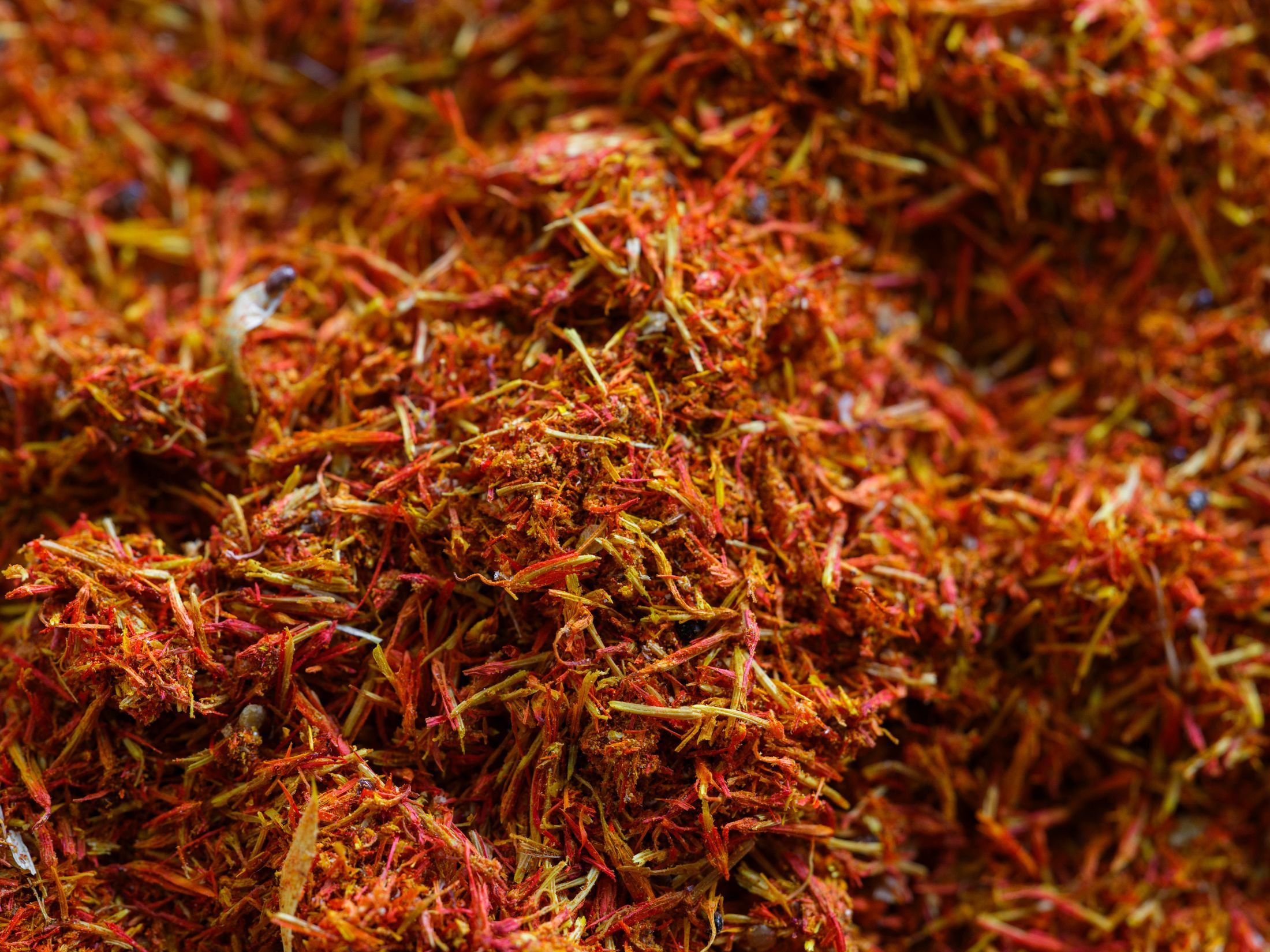
Saffron powder is those same stigmas ground. In theory it is the same product. In practice the question is always: ground from what? Whole top-grade threads, whole lower-grade threads with the style included, broken fragments and dust left over from sorting threads, or something that is not saffron at all. From the outside, every one of those looks identical.
Why threads are the safer purchase
You can inspect them. Good saffron threads are deep red along their whole length, with a flared, trumpet-shaped tip and a slightly thinner stem. A pale or yellow base means style was left on. Uniform, perfectly straight, identically coloured threads can mean dyed safflower or corn silk. Shape, colour variation and the smell from the vial tell you a lot before you spend anything. How to spot fake saffron goes through nine checks.
They keep. The aroma compound safranal is volatile. In a whole thread, most of it is protected inside the plant tissue and escapes slowly. Grinding tears that tissue open and multiplies the surface area many times, so powder loses aroma in months rather than years. The storage rules in how to store saffron apply to both, but threads forgive more.
They are hard to fake. Making a convincing fake thread is laborious. Making a convincing fake powder is as easy as mixing turmeric and paprika, which is why surveys of retail saffron over the years have consistently found higher adulteration rates in ground samples. ISO 3632 testing, which measures colour strength by spectrophotometer, is the one check that works on powder, and you should expect any powder seller to publish it.
You can measure them. Counting threads is a reliable way to dose saffron. Fifteen to twenty threads for a dish for four is easy to see. A pinch of powder is not.
Where powder genuinely wins
Speed. Powder dissolves straight into hot liquid. If you are finishing a sauce or a risotto and forgot to bloom threads, powder saves the dish.
Even distribution in batters and doughs. For saffron buns, cakes and custards, powder spreads evenly through a dry mix without the specks of thread that some bakers dislike. Bloomed threads work too, but you must add them with the wet ingredients.
Dry rubs and spice blends. Threads do not mix into a dry rub. Ground saffron does.
Very small doses. For a single cup of tea or milk, a tiny pinch of powder is easier to judge than counting four threads.
In every one of these cases, powder you ground yourself from good threads is better than powder you bought, because it is fresh and you know what went into it.
Converting threads to powder
Measurements for saffron are small enough that kitchen scales rarely help, so use these rules of thumb:
| Threads | Approximate weight | Ground volume | Typical use |
|---|---|---|---|
| 4 to 6 | 0.01 g | a few grains | one cup of milk or tea |
| 10 to 12 | 0.025 g | small pinch | rice or dessert for two |
| 15 to 20 | 0.04 g | 1/16 tsp (generous pinch) | rice, stew or dessert for four |
| 30 to 40 | 0.08 g | 1/8 tsp | a large biryani for eight, a batch of buns |
| 1 g | 1 g | about 1/2 tsp, loosely | 20 to 30 dishes |
One gram of good Kashmiri saffron holds roughly 400 to 500 threads. If you remember nothing else, remember that a dish for four needs about 20 threads, and that 20 threads grind to a pinch, not a spoonful.
How to grind saffron threads at home
You need a small mortar and pestle, or at a push the back of a spoon and a small bowl.
- Dry the threads. Saffron picks up a little humidity in storage and damp threads smear rather than grind. If a thread bends instead of snapping, lay the threads on a dry plate set over a pan of just-boiled water, off the heat, for two or three minutes. Do not toast them in a dry pan; it is easy to scorch and the aroma goes with the smoke.
- Add an abrasive. Put the threads in the mortar with a pinch of granulated sugar, or coarse salt for savoury dishes. The grains help break the threads down and stop the powder sticking to the pestle.
- Grind in circles for about a minute until you have a fine orange-red powder. Twenty threads take under a minute.
- Use it now. Stir the powder straight into hot liquid, or into the wet ingredients of a batter. If you must store it, put it in a tiny airtight jar, in the dark, and use it within a few weeks.
Grind only what you need for that day’s cooking. The whole point of buying threads is that they keep.
Buying powder anyway
If you prefer buying powder, buy it from a seller that publishes a per-batch ISO 3632 colour strength for the powder itself, in small sealed foil sachets rather than open jars, and taste it: real saffron powder has a clear bitter edge and a honey-hay perfume, while turmeric-based fakes taste earthy and mustardy. The flavour tells are in what does saffron taste like.
We sell threads only, in vials from 0.5 g to 10 g, with the lot’s ISO 3632 colour strength printed on the label. Every lot report is on the verify page, and sizes and prices are on the saffron page.
Read next: Saffron grades and ISO 3632 explained and How to use saffron.
Questions people ask
Are saffron threads or powder better?
Threads, for almost everyone. Whole threads can be inspected for colour and shape, keep their aroma for about two years, and are much harder to adulterate. Powder loses aroma within months, cannot be inspected, and is the form most often cut with turmeric, paprika or dye. Powder's one advantage is that it dissolves instantly, so if you need that, grind threads yourself as you go.
How much saffron powder equals a pinch of threads?
A generous pinch of 15 to 20 threads weighs about 0.04 g and grinds to roughly a sixteenth of a teaspoon of powder, which is a small pinch between finger and thumb. If a recipe calls for a quarter teaspoon of saffron powder, that is a very large amount, close to 0.5 g, and is probably written for a weak or cut powder. Start with far less.
How do I grind saffron threads at home?
Make sure the threads are completely dry; if they bend rather than snap, warm them on a dry plate over a pan of just-boiled water for a few minutes. Put the threads in a small mortar with a pinch of granulated sugar or coarse salt to act as an abrasive and grind in circles for about a minute. Use immediately or store airtight for no more than a few weeks.
Is saffron powder real saffron?
Sometimes. Reputable Spanish and Persian brands sell genuine ground saffron in small foil sachets, usually 0.1 to 0.125 g. But because powder cannot be inspected, it is the form fraudsters prefer, and studies of retail saffron routinely find ground samples cut with turmeric, safflower or synthetic dyes. Buy powder only from a brand that publishes ISO 3632 results, or buy threads and grind them.
Does saffron powder need to be bloomed?
No, which is its main convenience. Powder disperses straight into hot liquid or batter. Threads should be steeped in a few tablespoons of warm water or milk for 15 to 20 minutes before use, otherwise much of their colour and aroma stays locked in the thread.
Written by the Kashmiri Treasures team in Srinagar. We buy at the field in Pampore, test every lot to ISO 3632, and print the result on the vial. See who we are or verify a lot.