How to Spot Fake Saffron: 9 Tests You Can Do at Home
Learn how to spot fake saffron with nine kitchen tests: the cold-water bloom, thread shape, taste, smell, price and the one check that beats every trick.
By Kashmiri Treasures · October 7, 2026 · 11 min read
Saffron is faked more than any other spice for one simple reason: a gram of genuine Kashmir saffron retails internationally at USD 18 to 21, and most buyers have never held the real thing. Dyed corn silk, safflower petals, shredded paper, syrup-soaked threads and powder cut with turmeric all reach kitchens every year. One seller’s summary of a 2025 peer-reviewed study puts adulteration at up to 60 percent of saffron sold in India and 20 to 30 percent of saffron worldwide, and Indian food-safety labs flagged a 22 percent rise in adulterated saffron samples in the first quarter of 2026.
The good news is that you do not need a laboratory to catch most fakes. You need a glass of cold water, your fingertips, your nose, and about twenty minutes. The nine tests below go from the quickest to the most conclusive, and the last one, the paperwork test, is the only one that catches the clever fakes.
We buy our saffron at the field in Pampore and send every lot to an accredited lab, so we have seen plenty of both. Here is how to tell real saffron vs fake at your own kitchen table.
Real saffron vs fake saffron at a glance
Most fakes fail three or four of these rows at once.
| Sign | Real saffron | Fake or adulterated saffron |
|---|---|---|
| Thread shape | Thin tube flaring to a trumpet tip with a tiny serrated edge | Flat ribbons, uniform cut pieces, round florets, or fibres with no flare |
| Colour of thread | Deep crimson, slightly darker at the tip, sometimes a trace of orange at the base | Uniform bright red or orange, no gradient, or pale after soaking |
| Cold-water bloom | Golden yellow spreads slowly over 10 to 20 minutes; thread stays red | Red or orange bleeds within seconds; thread turns pale or white |
| Taste | Bitter, slightly floral, lingering | Sweet, sour, or no taste at all |
| Smell | Hay, honey, a faint metallic edge | Chemical, musty, sweet, or nothing |
| Rub test | Yellow-orange stain on wet fingertips, thread stays intact | Red stain, or thread crumbles to dust or pulp |
| Float | Floats at first, slowly sinks as it hydrates | Sinks like a stone (weighted) or never sinks (waxed) |
| Price | Roughly USD 8 per gram or more at retail | Well under USD 8 per gram, especially in large packs |
| Paperwork | Per-batch ISO 3632 report with batch code and accredited lab | Generic certificate, no batch code, or no report at all |
The saffron water test and six more physical checks (tests 1 to 7)
Test 1: The saffron water test (cold-water bloom)
Put three or four threads into a small glass of cold water. Do not stir. Watch the colour for the first minute, then come back after ten and twenty minutes.
Real saffron behaves slowly. The water around each thread turns a clear golden yellow and the colour drifts outward in thin streaks. After fifteen to twenty minutes the glass is golden and the threads are still deep red, slightly swollen.
Fake saffron behaves fast. Synthetic dye leaves a thread in seconds, so the water goes orange or red almost at once, often cloudy, and the thread itself fades to pale yellow or white. One buyer review of a bad lot described exactly this: strands that “changed color to pale yellow after 36 hours in water.”
Use cold or room-temperature water: hot water speeds up both real and fake colour release and hides the difference.
Test 2: The shape test (look for the trumpet)
A saffron thread is one of the three stigmas of the Crocus sativus flower. Each stigma is a thin tube that widens at the top into a tiny trumpet with a serrated or frilled edge. That trumpet is hard to fake.
Spread a few threads on white paper and zoom in with your phone camera. You should see:
- A narrow base, sometimes with a trace of orange or yellow where it joined the style
- A thicker, darker tip that flares out like a trumpet or a tiny funnel
- Natural variation in length and curve; no two threads identical
Safflower florets, the most common substitute, are short, tubular, orange-red and split into a five-point star at the top, with no serrated trumpet. Dyed corn silk is a smooth, uniform fibre with no flare. Shredded, dyed paper is flat and ribbon-like.
Mongra grade, the Kashmiri trade name for stigma-only saffron, should show no yellow style at all. A little yellow is not a fake; it just means you have a Lacha grade, which should cost less. We explain the difference in our guide to saffron grades and ISO 3632.
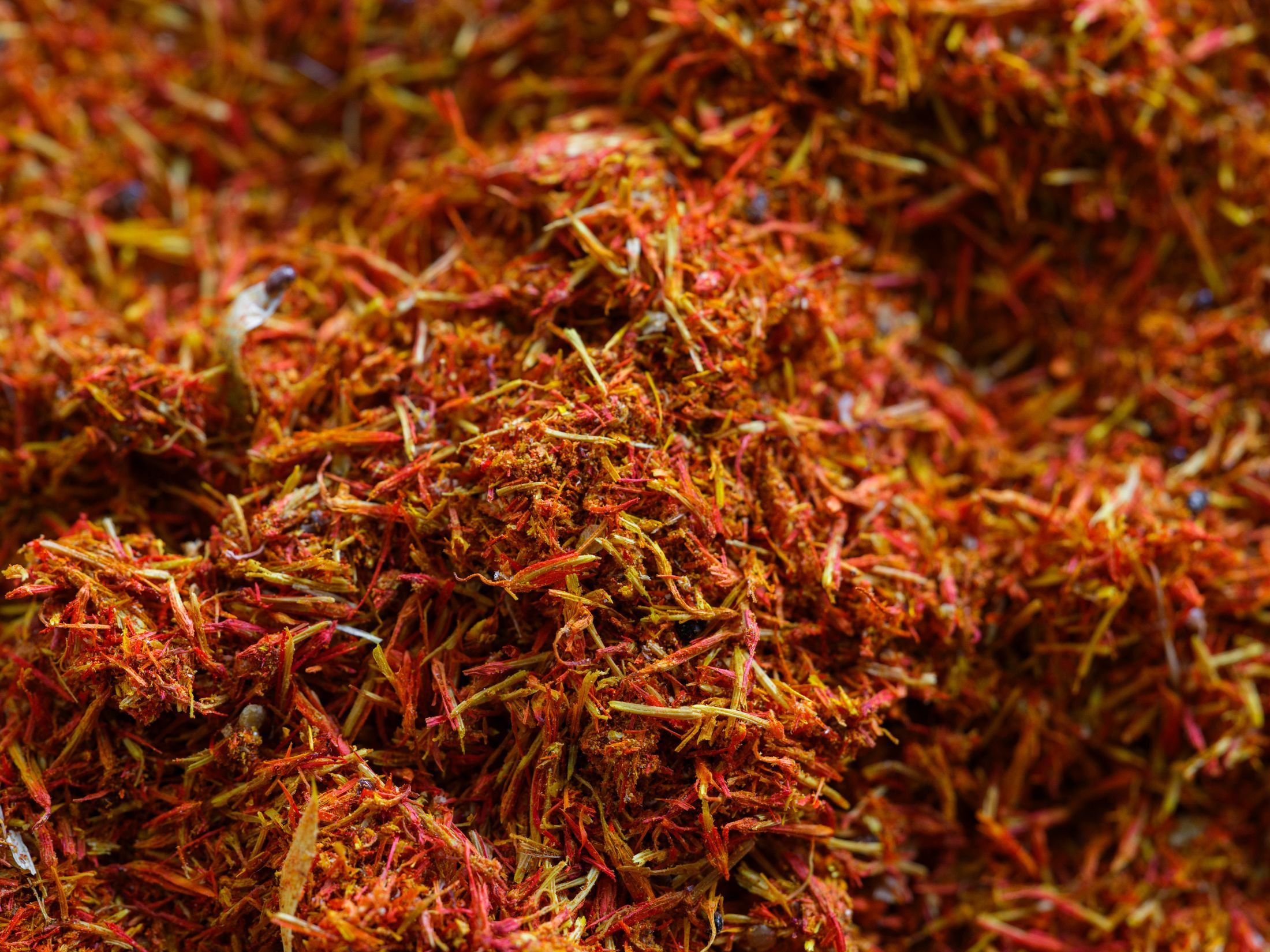
Test 3: The rub test
Wet your thumb and forefinger, then rub one thread between them for ten seconds.
Real saffron leaves a yellow-orange stain on your skin, smells of hay and honey, and the thread itself stays whole, if a bit bruised. It does not fall apart.
Dyed fakes leave a red or pink stain, because the dye sits on the surface. Paper and corn silk disintegrate into pulp. Safflower leaves little colour at all.
Test 4: The taste test (bitter, never sweet)
Place one thread on your tongue and hold it there for thirty seconds.
Genuine saffron is bitter, from picrocrocin, the compound an ISO 3632 lab measures as the taste reading. Behind the bitterness you may pick up a floral, slightly honeyed note.
What is not normal is sweetness. Saffron is sometimes soaked in sugar syrup, honey or glycerine to add weight, since it is sold by the gram. A sweet thread has been treated. A sour, chemical or totally flat taste is also a bad sign.
Test 5: The smell test
Open the jar and smell it. Fresh saffron smells of sweet hay, honey, dried roses and a faint metallic edge. Reviewers of good Kashmiri saffron tend to use the same word, “fragrant,” and Cook’s Illustrated notes that deep, dark red threads outperform yellow or orange ones, as summarised in their guide to buying saffron.
Fakes smell of nothing, of damp cardboard, or of something chemical. Old, badly stored saffron loses aroma too, so a weak smell does not always mean a fake, but it does mean you are not getting what you paid for. Safranal, the aroma compound, fades with light, heat and air, which is why we pack in dark glass and print the harvest date on the vial.
Test 6: The float test
Drop a pinch of dry threads onto the surface of a glass of water without pushing them under.
Real saffron floats for a few seconds to a minute, then threads hydrate and drift down slowly. Threads that drop like stones are often weighted with syrup, oil or mineral powder. Threads that never take on water may be waxed. This is a soft test, so treat it as one more signal rather than a verdict.
Test 7: The burn and ash test
Hold a single dry thread with tweezers over a heatproof dish and touch a flame to it. Real saffron burns quickly, like any dry plant material, with a roasted, slightly sweet smell, and leaves a trace of light grey ash. Synthetic fibres and glossy paper melt, curl or smoke with a plastic smell and may leave a hard bead. A thread that fizzes or sparks suggests mineral weighting. Burn one or two threads only; this is a confirmation step, not a routine check.
The price test and the paperwork test (tests 8 and 9)
Test 8: The price test
Saffron is expensive because it is slow to grow and slow to pick. Each flower gives three stigmas, the Kashmir bloom lasts two to three weeks each October, and the whole of Jammu and Kashmir produced 19.58 tonnes in 2024-25, according to Outlook Business.
Trade guidance in the Alibaba spice price guide is blunt: if a product lists saffron for less than USD 8 per gram, it is highly likely to be adulterated or mislabelled. On the research date for our market notes, retail prices per gram in the US ran roughly: Kashmiri Mongra USD 18 to 21, Afghan Super Negin 10 to 16, Persian Super Negin 5 to 10, Spanish Coupe about 7 to 14. Large packs bring the per-gram price down, which is why Persian saffron can legitimately sit near the bottom of that range.
What should worry you is a listing well below the floor, such as a 4 g pack for GBP 7.99, about GBP 2 per gram, flagged on a UK cooking forum. At that price something other than saffron is paying the bill. Price is a filter, not a proof: a high price with a smart label can still hide a weak or old lot, which is why the next test matters most.
Test 9: The paperwork test (ISO 3632 report and NABL ULR)
Every test above can be fooled by a careful fraud: exhausted saffron re-dyed, a good lot blended with a bad one, Iranian saffron relabelled as Kashmiri. The only check that defeats all of these is a laboratory report for the specific batch you are buying.
Ask the seller for an ISO 3632 report for the lot. A proper report shows:
| Measure | What it tells you | ISO 3632 Category I |
|---|---|---|
| Crocin (colouring strength, 440 nm) | How much colour the saffron will give | 200 or higher |
| Picrocrocin (bitterness, 257 nm) | Taste strength | 70 or higher |
| Safranal (aroma, 330 nm) | Fragrance | 20 to 50 |
It should also state moisture (12 percent or below), floral waste, and a line for artificial colourants reading “not detected.” The batch code on the report must match the batch code on the pack.
In India, the strongest version is a report from a NABL-accredited lab, which carries a ULR (Unique Laboratory Report) number you can verify on the Quality Council of India portal. Red flags: a missing ULR, a batch mismatch, a pixelated or edited PDF, no ISO 3632 values, or lapsed accreditation.
This is why every Kashmiri Treasures vial prints its lot code, crocin number, harvest date and grower name on the label. Type the lot code into our verify page and you will see the full report for that batch. If a seller cannot show you something equivalent, you are buying on faith.
The most common saffron fakes and how each one fails
Safflower (the “poor man’s saffron”)
Safflower florets are orange-red, cheap and legal under their own name; the fraud is calling them saffron. They fail the shape test (five-point star, no trumpet), the water test (weak orange tint, no aroma) and the taste test (no bitterness). We cover why safflower cannot replace saffron in saffron vs turmeric and other substitutes.
Dyed corn silk and corn husk
Corn silk is a fine, smooth fibre that takes dye well. It fails the water test spectacularly: the colour washes out almost instantly and the fibre goes white. It also fails the rub test, turning to pulp.
Dyed paper
Shredded, dyed paper looks convincing in a sealed jar. In water it bleeds red, goes soft and falls apart; between wet fingers it becomes mush. Dyed marigold petals and beetroot fibre, less common, fail the same tests.
Syrup-weighted threads
Real saffron soaked in sugar syrup, honey or glycerine so that a gram contains fewer threads. It passes the shape test and often the colour test. It fails the taste test (sweet) and the float test (sinks fast), and often feels tacky or clumped in the jar.
Saffron powder cut with turmeric or paprika
Ground saffron is the easiest product to adulterate because nothing visual survives grinding. Turmeric gives the yellow, paprika or dye gives the red, and a little real saffron gives the smell. It fails the water test (cloudy, orange, sediment) and the taste test (earthy, not bitter). Buy whole threads and grind at home.
Relabelled origin
The subtlest “fake” is genuine saffron from one country sold under another name. It is not always poor saffron, but it is not what you paid for. Kashmir’s Geographical Indication, GI No. 635, protects the name at origin; abroad, the only confirmation is traceability: a named grower, a harvest date and a lab number that matches. See our Kashmir saffron GI tag guide.
What to do if your saffron fails a test
If the water turns red in seconds, the threads taste sweet, or the seller cannot produce a batch report, do not cook with it and do not throw it away yet. Photograph the test, keep the packaging and ask for a refund; on marketplaces a water test photo is usually enough to win a dispute.
Then buy from a seller who shows their work: whole threads, a harvest date, a batch code, an ISO 3632 report you can open, and a return policy that does not make you argue. Ours is on our shipping and returns page, and the questions we hear most often are answered on our FAQ.
Read next
Once you can tell real from fake, the next question is grade. Read Saffron Grades Explained: Mongra vs Lacha, ISO 3632 and How to Read a Lab Report to understand what the numbers on a report mean, and then Kashmiri vs Persian vs Spanish Saffron to decide which origin suits your cooking and your budget.
Questions people ask
What is the quickest way to tell real saffron from fake?
Drop three threads into a small glass of cold water and wait. Real saffron colours the water a clear golden yellow slowly, over ten to twenty minutes, and the threads stay deep red. Dyed fakes bleed orange or red within seconds and the threads themselves turn pale. Pair this with a taste check: genuine saffron is bitter and slightly floral, never sweet. If a sample fails either test, do not cook with it.
Does real saffron dissolve in water?
No. A genuine saffron thread never dissolves. It softens, swells slightly and releases crocin, the water-soluble pigment, which is why the water turns gold while the thread keeps its crimson colour. If a thread breaks apart into pulp, disappears, or leaves the water red rather than yellow, you are most likely looking at dyed plant fibre, paper or a syrup-coated imitation.
Why is saffron so often faked?
Because it is light, expensive and most people have never handled the real thing. One gram of Kashmiri Mongra retails internationally at about USD 18 to 21, so adding weight with syrup, or swapping in safflower or dyed corn silk, is very profitable. One seller summary of a 2025 study puts adulteration at up to 60 percent of saffron sold in India and 20 to 30 percent worldwide, which is why a per-batch lab report matters more than any home test.
Is saffron powder more likely to be fake than threads?
Yes. Once saffron is ground, you lose every visual check: thread shape, trumpet tip, colour gradient and the slow bloom. Powder is easily cut with turmeric, paprika or synthetic colourants and still looks right in the jar. We only sell whole Mongra threads for this reason. If you need powder, grind a few threads yourself in a mortar just before cooking; you get fresher aroma and you know what went in.
How much should real saffron cost per gram?
Trade guidance is that saffron listed under about USD 8 per gram is very likely adulterated or mislabelled. In 2026, Persian Super Negin sells at roughly USD 5 to 10 per gram in larger packs, Afghan at 10 to 16, and Kashmiri Mongra at 18 to 21 per gram. Price is only a filter, not proof: an expensive label can still hide a weak lot, which is why we print the crocin number on every vial.
What should a saffron lab report show?
An ISO 3632 report lists three readings from a spectrophotometer: crocin for colour (Category I is 200 or higher), picrocrocin for bitterness (70 or higher) and safranal for aroma (20 to 50). It should also give moisture, floral waste, a result for artificial colourants, the batch code that matches your pack, and the lab's accreditation. In India, a NABL-accredited lab adds a ULR number you can check on the QCI portal.
Written by the Kashmiri Treasures team in Srinagar. We buy at the field in Pampore, test every lot to ISO 3632, and print the result on the vial. See who we are or verify a lot.