How to Grow Saffron at Home: Corms, Planting, Harvest, and How Much You Will Really Get
A realistic guide to growing saffron crocus at home: buying corms, when and how to plant, soil and pots, the autumn harvest, drying, dividing corms and honest yields.
By Kashmiri Treasures · October 31, 2026 · 6 min read
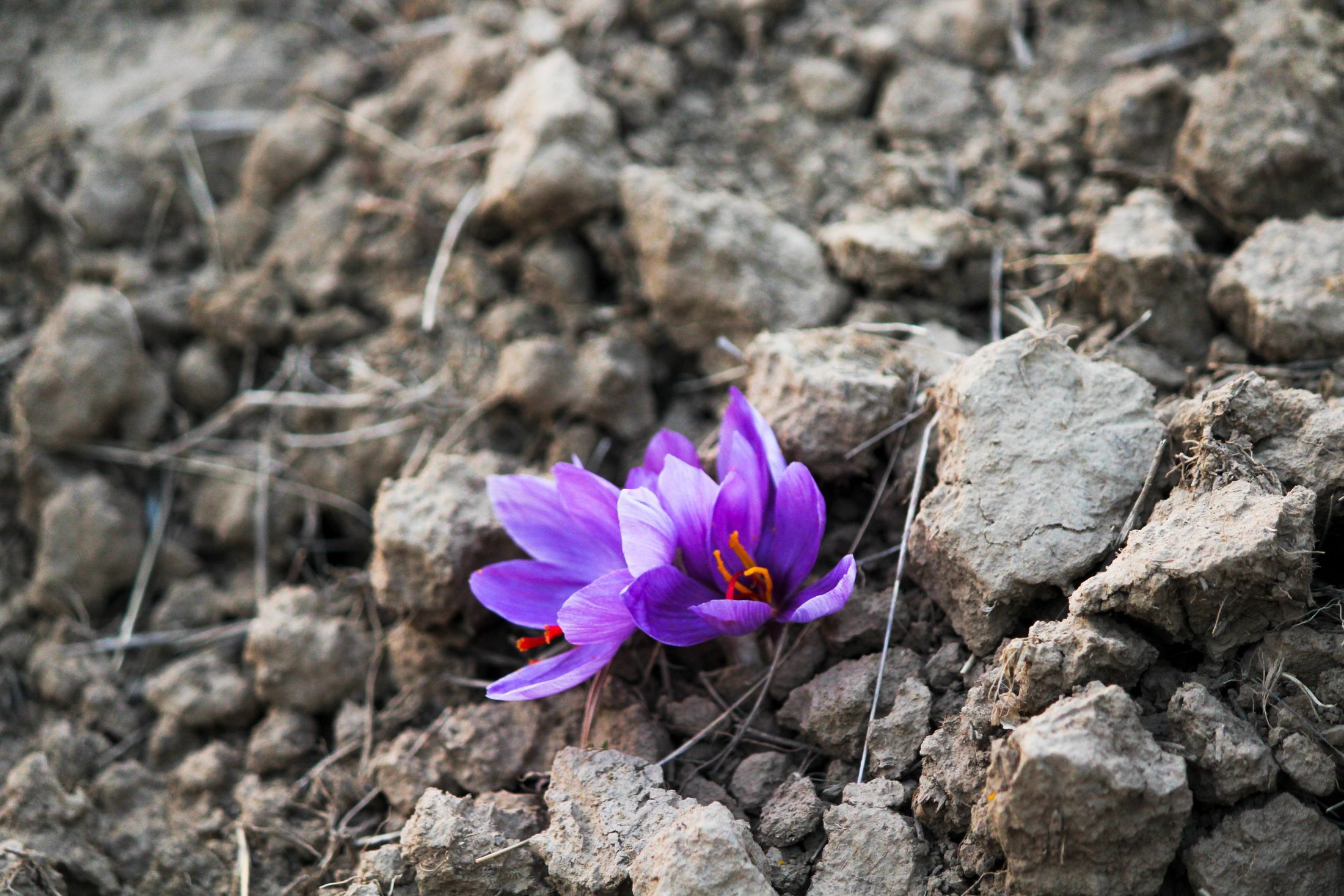
Saffron is one of the easiest expensive things to grow and one of the hardest to harvest. The crocus itself asks for little: a sunny spot, soil that drains, corms planted in late summer, and a dry rest in summer. Six to ten weeks after planting, small lilac flowers open with three red stigmas inside. Then the real work begins, because those three threads must be picked by hand the morning the flower opens, and it takes about 150 flowers to make a single gram.
This guide is written for a home grower who wants a few grams a year and a closer understanding of the spice, not for anyone hoping to save money. Fifty corms, a few square metres and an hour or two of picking across three autumn weeks will give you a gram or two of your own saffron, and the sight of a bed of saffron crocus in October is worth the trouble on its own.
What you are growing
Crocus sativus is an autumn-flowering crocus, not the spring one. It grows from a corm, a swollen underground stem the size of a chestnut, that goes dormant in summer, sends up flowers in autumn, grows grass-like leaves through winter, and dies back in late spring having produced several daughter corms. It is a sterile triploid and makes no seed; everything is grown by dividing corms. The history of saffron explains how one sterile plant spread across three continents.
It is hardy to roughly minus 15°C, dislikes wet feet above all things, and needs a warm dry summer to ripen the corms. Mediterranean, continental and temperate climates with dryish summers suit it: the Pampore plateau at 1,600 metres, La Mancha, Khorasan, and much of the US from zone 6 to 9, southern England, and the drier parts of Australia and Canada.
Buying corms
Buy from a nursery or bulb merchant that lists Crocus sativus by name, in late summer when they ship. Corms are graded by circumference; 8 to 10 cm corms flower reliably in the first year, smaller ones may wait a year. Expect to pay roughly a dollar a corm in small quantities, less in hundreds.
How many: each corm gives one to three flowers in its first autumn, and 150 flowers make a gram, so 50 to 75 corms give about a gram the first year. Corms multiply, so the same planting gives several grams by year three. Fifty is a good start for a household; 200 to 300 for a serious hobby bed.
Do not try to grow saffron from the spice. Threads are stigmas, not seeds.
Where and when to plant
Site. Full sun, and soil that drains freely. Raised beds, gritty loam, slopes and sandy soil are ideal; heavy clay that holds winter wet will rot the corms. Work in coarse sand or grit if in doubt. Soil pH of 6 to 8 is fine.
Time. Late summer: August to early September in the northern hemisphere, February to March in the southern. Corms need a few weeks to root before they flower.
Depth and spacing. Plant 10 to 15 cm deep, pointed end up, 10 cm apart in rows 15 to 20 cm apart. Deeper planting gives fewer but larger daughter corms and better protection from frost and rodents; shallower gives more, smaller ones.
Pots. At least 15 cm deep, with drainage holes and a gritty mix; six to eight corms in a 25 cm pot. Pots dry out faster, which saffron likes in summer and tolerates in autumn. Protect pots from hard frost in winter by moving them against a wall or into a cold frame.
Water. Water in after planting, then only if the autumn is very dry. Winter rain is usually enough. Stop watering completely when the leaves yellow in late spring; the corms must bake dry through summer.
Flowering and harvest
Flowers appear six to ten weeks after planting, usually in October and early November in the northern hemisphere, and the bloom lasts two to three weeks. Each flower opens for a day or two. Pick in the morning, before the sun is fully on the flowers, pinching the whole flower off at its base; it is easier to extract the stigmas indoors at a table than in the bed.
With a thumbnail or small scissors, remove the three red stigmas from each flower. Trim away the pale yellow part of the style where it joins the red; the red tip alone is the top grade, Mongra in Kashmir, and the yellow adds weight and nothing else. Discard the petals and the three yellow stamens, which are not saffron. How saffron is harvested in Pampore shows how it is done at scale.
Drying
Spread the stigmas in a single layer on kitchen paper or a fine sieve and dry them in a warm, airy, shaded place for a few days, until they are brittle and snap rather than bend. In a damp climate, a dehydrator at its lowest setting, or an oven with the door ajar at under 50°C, for 20 to 30 minutes does it; do not scorch them. Dried saffron weighs about a fifth of its fresh weight. Store airtight and dark, and let it rest a month before using; the aroma develops as safranal forms during curing. How to store saffron applies to your own as much as bought.
After flowering
Leaves grow through winter and look like coarse grass; leave them, they feed the corms. In late spring they yellow and die back. Stop watering. The corms are dormant through summer and want to be dry and warm.
Every three to four years, in June or July, lift the clumps, separate the daughter corms, discard any that are soft, and replant the largest in August in fresh ground or refreshed soil. Yields rise as the bed thickens and then fall when it becomes congested, so dividing is what keeps it productive.
Pests are few. Mice, voles and squirrels dig up corms; a layer of wire mesh over the bed or planting in buried pots stops them. Fungal rot follows wet soil and is prevented, not cured.
What you will get
Year one, from 50 corms: about a gram, perhaps less. Year three, after multiplication: several grams, enough for a household’s cooking. A dozen cups of saffron milk and a few biryanis, from your own garden, with the smell of the fresh stigmas on your fingers in October. That is the return, and it is a good one, but nobody saves money growing saffron at home, which tells you most of what you need to know about why it costs what it does. Why is saffron so expensive has the arithmetic.
Your own saffron is also the best possible reference for judging bought saffron. Once you know what fresh, stigma-only threads look, smell and taste like, fakes are obvious. For the years when the harvest is small, the Pampore lot, with its grower and lab report, is on the saffron page.
Read next: How saffron is harvested in Pampore and Visiting the saffron fields of Pampore.
Questions people ask
Can you grow saffron at home?
Yes, in a garden bed or in deep pots, anywhere with hot dry summers, a cool autumn and winters that do not stay below about minus 15°C for long. Plant corms in late summer, flowers appear six to ten weeks later, and you harvest the three red stigmas from each flower by hand. It is easy to grow and laborious to harvest, which is the whole story of saffron.
How many saffron corms do I need for 1 gram of saffron?
About 50 to 75 corms in their first year, since each gives one to three flowers and about 150 flowers make a gram. By the third year, when corms have multiplied, the same bed may give several grams. For a household that cooks with saffron, 50 corms is a sensible start.
When should I plant saffron corms?
Late summer, August to early September in the northern hemisphere, so the corms root before flowering in October and November. Suppliers ship corms in that window. Planting later than mid-September usually means few or no flowers the first autumn.
Can I grow saffron from the spice?
No. Saffron threads are dried stigmas, not seeds, and the saffron crocus is sterile and produces no viable seed in any case. You must buy corms, the bulb-like underground stems, from a nursery that sells Crocus sativus.
Can I grow saffron indoors?
In pots on a sunny windowsill or under a grow light, yes, provided the pots are at least 15 cm deep, drain well, and the plants get a cold rest in winter, for instance in an unheated room or a cold frame. Indoor saffron needs a dry dormant summer too, so stop watering once the leaves die back.
Written by the Kashmiri Treasures team in Srinagar. We buy at the field in Pampore, test every lot to ISO 3632, and print the result on the vial. See who we are or verify a lot.