How Kashmir Saffron Is Harvested: From Corm to Vial in Pampore
How is saffron harvested? Follow Pampore's October bloom from corm to vial: dawn picking, 150 flowers a gram, same-day separation, drying and ISO 3632 testing.
By Kashmiri Treasures · October 7, 2026 · 10 min read
Saffron is harvested by hand, flower by flower, during a bloom that lasts two to three weeks in late October. Pickers go into the fields at dawn, before the sun opens and wilts the purple flowers, and gather them into baskets. Later the same day, the three red stigmas are pulled from each flower and separated from the pale style. Then the threads are dried slowly until they lose roughly four-fifths of their weight. About 150 flowers go into one gram.
That is the short answer to “how is saffron harvested”, and it is true anywhere the crocus is grown. What makes the Pampore harvest different is the place: Karewa plateaus 1,600 to 1,800 metres above sea level in the Kashmir valley, a crop protected by Geographical Indication No. 635, and a tradition of stigma-only Mongra grading.
We buy at the field, from named growers, and every vial we sell carries the lot code, the harvest dates, the grower’s name and the crocin number from the lab. This is the whole journey, from a dormant corm in August to the vial you can check on our verify page.
The corm: where a saffron harvest begins
The saffron crocus, Crocus sativus, is a sterile plant. It sets no viable seed, so every field in Pampore has been propagated for centuries from corms, the fleshy underground stems that look like small brown bulbs. A grower’s real capital is not the land or the flowers but the stock of corms in the ground.
Corms are lifted and replanted in late summer, typically August into early September, when the plant is dormant. They are set a hand’s depth into raised beds and left alone. Then the first autumn rain and the cooling nights wake the corm, and in October the flower pushes straight up through the soil, often before the grass-like leaves have fully emerged.
Each corm produces one to three flowers. Over the winter and spring the leaves feed the corm, which divides into daughter corms, and the cycle repeats. Traditional Kashmiri beds are replanted roughly every four to five years as the corms crowd and shrink. Fields replanted late give smaller flowers and fewer of them, and growers have cited poor corm stock as one reason for recent weak harvests.
The Karewa plateaus and why Pampore
Pampore sits on the Karewas, the flat-topped lacustrine plateaus south-east of Srinagar left behind by the ancient lake that once filled the Kashmir valley. The soil is deep, well drained and rich in clay and silt. It warms by day, cools sharply at night and does not waterlog: close to what a saffron corm wants.
Altitude matters too. At 1,600 to 1,800 metres the autumn days are bright and the nights cold when the crocus flowers, and that swing is widely credited for Kashmiri saffron’s high crocin readings. The GI registration, number 635, covers Pampore and neighbouring tehsils in Pulwama, Budgam, Srinagar and Kishtwar. The tehsils are small, and the traditional saffron area across Jammu and Kashmir is a little over 1,100 hectares. We explain the registration in Kashmir saffron GI tag explained.
The Karewas are almost entirely rain-fed. A dry September delays and thins the bloom; unseasonal rain at flowering knocks the petals down. Growers talk about those weeks the way wine growers talk about a vintage.
The bloom window and picking at dawn
Two to three weeks in late October
The flowers come all at once. In most years the first blooms appear in the second half of October, the field peaks about a week later, and by early November the plateau is back to bare brown beds with a fringe of green leaves. Two to three weeks, start to finish.
A single flower lasts a day or two. That is the detail that shapes the whole harvest. You cannot wait for the field to finish flowering and then pick. You walk the same rows every morning, taking what opened overnight, for the entire window. Our current lot, KT25A, was picked between 24 October and 8 November 2025 on Ghulam Nabi Bhat’s plot at Lethpora, on the edge of Pampore, at 1,640 metres.
Why the picking starts at first light
Picking starts at dawn and is usually finished by mid-morning, for three reasons that are all about quality.
First, the flowers are fully open and firm at dawn, with the dew still on them, so they come away from the stem cleanly. Second, sun and warmth wilt the petals within hours, and a wilted flower is slower and messier to process. Third, and most important, the aroma compound safranal is volatile. The longer a picked flower sits in warm air, the more of it escapes. Picking cold and processing fast is how you keep the perfume in the thread.
Pickers carry shallow wicker baskets and pinch the flower off at the base of the stem. On a family plot it is the family that picks: Ghulam Nabi Bhat goes out with his daughters. Larger plots hire day labour for the fortnight, and picker wages in Pampore have risen sharply in recent seasons.
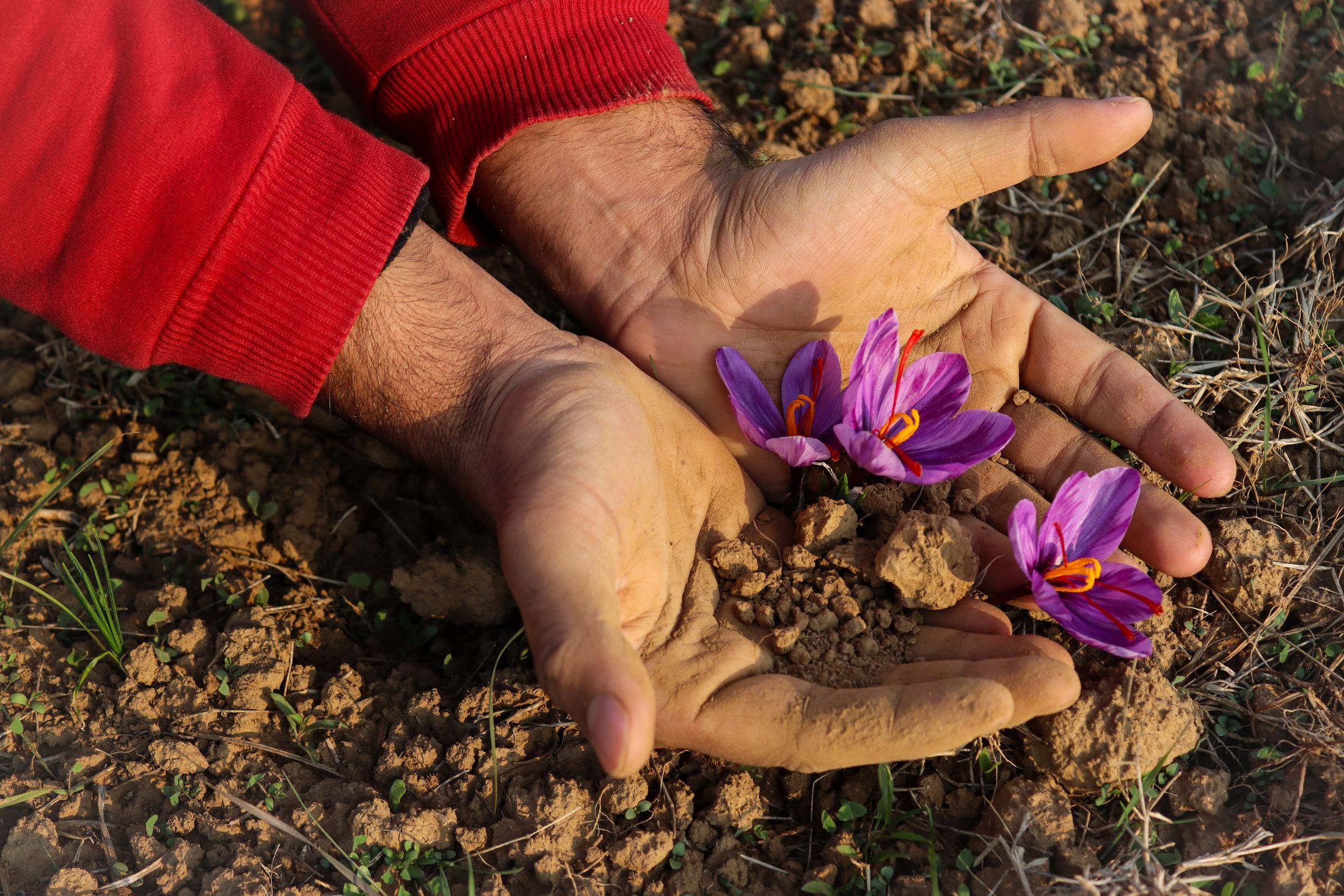
The counting: three stigmas, 150 flowers, one gram
Open a saffron flower and you find six purple petals, three yellow stamens that are of no use, and a single pale style that splits into three deep-red stigmas. The stigmas are the spice.
Drying removes roughly four-fifths of the fresh weight. The arithmetic every Pampore family knows by heart runs like this: about 150 flowers for one dried gram of Mongra, three stigmas per flower, so around 450 threads in a gram, each about 2 mg. A kilogram is something like 150,000 flowers.
This is the honest answer to “why is saffron so expensive”. Nothing in the process is mechanised, the yield per flower is tiny, and the bloom will not wait.
Separation the same day: Mongra versus Lacha
The baskets go indoors by late morning and the second job begins. Each flower is opened and the red stigmas are pulled free. In Kashmir this is done at a low table, usually by the women of the household, with the flowers on one side and a cloth for the threads on the other.
What happens next decides the grade. If the three red stigmas are snipped away from the pale yellow style at this stage, the result is Mongra: stigma only, deep crimson, nothing in the thread that does not carry colour and aroma. If part of the style is left attached, the result is Lacha: more weight per flower, but the style adds nothing to the dish. Both names are protected by the GI, and both are honest when labelled. We buy and sell Mongra only, because the lab numbers depend on it and because a thread with yellow in it is the first thing a customer notices. The grading system is explained fully in saffron grades and ISO 3632.
Separation has to happen the same day. Flowers left overnight go limp, the stigmas stick to the petals and the threads bruise. On a peak day a family may process several thousand flowers between noon and dark.
Drying: shade, low heat, under 12 percent moisture
Fresh stigmas are soft and wet. They have to be dried quickly enough to prevent mould and slowly enough to keep the crocin and safranal intact.
The traditional Pampore method is shade drying: threads spread thinly on cloth or paper indoors, away from sun, turned regularly, for several days. Some households use a very low, indirect heat to finish. What growers avoid is direct sun and high heat, both of which bleach the colour and drive off aroma. Properly dried threads are brittle, snap cleanly and have a dry, almost metallic sheen on the red.
The target is a moisture content below 12 percent, which is the ISO 3632 limit for whole threads. Our current lot tested at 8.9 percent. Below that level the threads keep in a sealed glass vial for a year or more; above it they lose colour and can turn musty. Drying is the step most often rushed, and it is why two vials from the same village can taste completely different.
The lab step and the label
ISO 3632 sampling
Once a grower’s lot is dry, we draw a sample and send it to an NABL-accredited laboratory in India for ISO 3632 testing. The lab grinds the sample, extracts it in water and reads it on a spectrophotometer at three wavelengths: 440 nm for crocin (colouring strength), 257 nm for picrocrocin (bitterness) and 330 nm for safranal (aroma). It also checks moisture, floral waste and the presence of artificial colourants.
Category I requires crocin of at least 200. Lot KT25A read 248, with picrocrocin at 92, safranal at 38, floral waste at 0.3 percent and artificial colourants not detected. Those numbers go on the vial. If a lot came back below Category I, or with anything detected under colourants, we would not sell it under our name. That is the point of testing every lot rather than trusting a reputation.
Packing and labelling
Dried, tested saffron is packed in Srinagar into glass vials with an airtight seal. Glass, because saffron picks up odours and loses aroma through plastic. Small, because a gram is a season of cooking for most households and we would rather you buy fresh than store a jar for years.
Every label carries the lot code, the harvest dates, the grower’s name and village, the ISO category and the crocin number from the lab report. The code is also in a QR that opens the lot’s page on our site. As far as we can tell, nobody else selling Kashmiri saffron internationally prints the crocin value on the pack.
Yields and economics: why a family plot produces so little
What the numbers look like
The official productivity figure for Jammu and Kashmir in 2024–25 was 5.27 kilograms per hectare, on a traditional area of 1,116 hectares, for a total crop of 19.58 tonnes. That is Kashmir’s entire crop for a year; Iran grows roughly nine-tenths of the world’s supply.
A family plot is a fraction of a hectare. Ghulam Nabi Bhat’s 1.2 acres is about half a hectare. In a good year that might give two or three kilograms of dried Mongra; in a bad one, a few hundred grams. The lot we bought from his plot in 2025 was 420 grams. Pampore growers widely reported the autumn of 2025 as a very poor season after dry spells and poor corm stock, though the state government disputes the extent of the shortfall. Either way, a grower cannot make up a lost year; the corm cycle takes several seasons to rebuild.
What growers earn, and why we pay above the auction
Most Pampore saffron is sold through the India International Kashmir Saffron Trading Centre at Pampore, which runs GI tagging, processing and an e-auction with several thousand registered growers and a few hundred buyers. Prices there have risen sharply with the short crops, but the grower still sells into a market where the price is set after the work is done and paid after the sale.
We do it the other way round. We agree a price per gram with the grower before the harvest, at a fixed premium above the Pampore auction price for Category I Mongra, and we pay on delivery of the dried lot, not after we have sold it. In return we get first pick of the lot, same-day separation and slow drying, and the right to put the grower’s name on the label. It costs more per gram than the auction. It also means a plot that produces 420 grams in a bad year is still worth tending next year, which is the only way this crop survives.
How we came to buy this way is on our story.
The saffron season, month by month
| Month | In the field | What it means for the saffron |
|---|---|---|
| June to July | Corms dormant. Beds weeded, some manure added. | Nothing visible. The corm is storing energy from spring. |
| August to early September | Corms lifted and replanted in beds due for renewal. | The decision that sets flower count for the next four to five years. |
| September | Dry weeks, then the first autumn rain. | Rain timing decides when the bloom starts and how strong it is. |
| Mid to late October | First flowers. Dawn picking begins. | Same-day separation into Mongra. Shade drying starts. |
| Late October to early November | Peak bloom, then the last flowers. | The busiest ten days of the year on the plateau. |
| November | Drying finished. Lots sampled for ISO 3632. Auction at Pampore. | We pay growers, pack in Srinagar and ship the new lot. |
| December to March | Leaves grow through the cold; snow on the Karewas. | Leaves feed the corm, which forms daughter corms. |
| April to May | Leaves yellow and die back. | The corm goes dormant with next year’s flowers already set inside it. |
How to check a vial yourself
Every vial we ship has a lot code on the label. Enter it on the verify page and you will see the grower, village and altitude, the harvest dates, the lab’s name and accreditation, the report number and the full ISO 3632 readings, with the report itself. If a seller cannot show you an equivalent, you are buying on trust rather than evidence. The saffron page shows the current lot and what is left of it.
Read next: Kashmir saffron GI tag explained and Saffron grades explained: Mongra, Lacha and ISO 3632.
Questions people ask
How many flowers does it take to make 1 gram of saffron?
Roughly 150 saffron crocus flowers go into one dried gram of Kashmiri Mongra. Each flower carries three red stigmas, so a gram is about 450 threads, each weighing around 2 mg. The fresh stigmas lose roughly four-fifths of their weight in drying, which is why a basket of flowers that fills a room with scent ends up as a few spoonfuls of spice.
When is saffron harvested in Kashmir?
The saffron crocus in Pampore flowers for a window of two to three weeks, usually from the second half of October into early November. Each flower opens for only a day or two, so pickers walk the same rows every morning for the whole window. Our current lot was picked between 24 October and 8 November 2025, and those dates are printed on the vial.
Why is saffron picked at dawn?
Flowers open overnight and are at their freshest at first light. Once the sun is up, petals wilt, the stigmas begin to dry unevenly, and the volatile safranal that carries the aroma starts to escape. Picking before the dew lifts also keeps the flower intact, which makes separating the stigma from the style cleaner and faster later in the day.
What is the difference between Mongra and Lacha saffron?
Mongra is the stigma only: the three deep-red tips snipped away from the pale yellow style the same day the flower is picked. Lacha keeps part of the style attached, which adds weight but no colour or aroma. Both are protected names under the Kashmir saffron GI registration, but Mongra is the premium grade and the only one we sell.
Why is saffron so expensive?
Every step is manual and the yield is tiny. A flower gives three stigmas, a gram needs about 150 flowers, and the whole bloom lasts two to three weeks. Kashmir's traditional saffron area is a little over 1,100 hectares, and the entire Jammu and Kashmir crop was 19.58 tonnes in 2024–25. Add same-day hand separation, slow drying and laboratory testing, and the price per gram follows.
How can I check that my saffron is really from Pampore?
Look for the Kashmir saffron GI registration (number 635), a lot code, a harvest date and a laboratory report you can read. On our vials the lot code, harvest dates, grower name and the lab's crocin number are printed on the label, and the matching ISO 3632 report is published on our verify page, where you can enter the code and see the full document.
Written by the Kashmiri Treasures team in Srinagar. We buy at the field in Pampore, test every lot to ISO 3632, and print the result on the vial. See who we are or verify a lot.