Kashmir Saffron GI Tag Explained: What GI No. 635 Protects and Why It Matters When You Buy
Kashmir saffron GI tag explained: what GI No. 635 protects, the districts and grades it covers, what it guarantees abroad and how to see it on a pack.
By Kashmiri Treasures · October 7, 2026 · 10 min read
The Kashmir saffron GI tag is Geographical Indication No. 635, registered in India in 2020. It reserves the name “Kashmir Saffron” for saffron grown in specified tehsils of four districts of Jammu and Kashmir, Pulwama, Budgam, Srinagar and Kishtwar, at 1,600 to 1,800 metres on the valley’s Karewa soils, and it defines the three grades that may carry the name: Mongra, Lachha and Guchhi.
That protection matters because Kashmir grows very little saffron, about 20 tonnes a year, while Iran grows roughly 90 percent of the world’s supply. The Kashmiri name commands the highest price of any origin, which makes it the most tempting label to borrow. The GI gives growers a legal tool against that inside India, and a trading centre in Pampore to enforce it.
What the GI cannot do is follow a parcel abroad. If you are buying in the US, UK, UAE or Australia, the GI tells you what Kashmir saffron is supposed to be; a lab report tied to a lot code tells you whether the vial in your hand is that. This guide explains both halves, because we buy GI-registered lots at the field in Pampore and test every one of them.
What a Geographical Indication is
A Geographical Indication is a form of intellectual property that links a product’s name to a place and to the qualities that place gives it. Champagne, Darjeeling tea and Parmigiano Reggiano are familiar examples. Unlike a trademark, a GI does not belong to one company. It belongs to the producers in the defined region, collectively, and anyone growing or making the product to the registered specification within that region may use the name.
A GI registration describes the product, the region, the production method and the characteristics that make it distinctive. For a food, that typically includes soil, climate, altitude, variety and processing, plus the quality standards the product must meet. Once registered, selling something from outside the region under the protected name is an infringement in the registering country.
For Kashmir saffron, the GI is the first formal, legally recognised definition of what the name means. Before 2020, “Kashmiri saffron” was a reputation. Since 2020 it has been a specification.
The 2020 registration: GI No. 635
Kashmir saffron’s GI application was filed under number 635 and the certification was granted in 2020, with the Tribune and other Indian press reporting the award that summer. Some seller pages date the award to 2019, when the application was filed; the registration itself is widely reported as 2020, and the GI registry entry is the authority if you want to check.
The effect on the market was quick. The Tribune later reported that with the GI tag the crop had “successfully fought off competition from Iranian saffron” and that the tag had elevated its market value. By July 2023 Indian business press was crediting the GI tag and the new trading centre with a revival of the market, with Kashmiri saffron at ₹3,250 per 10 grams.
In late 2025 the Indian government went further and tightened export documentation for high-value agricultural products including saffron, specifically to combat mislabelling and protect the integrity of the GI. For buyers abroad, that means legitimate exporters now carry more paperwork, and sellers quoting suspiciously easy shipping should be asked how.
Where GI Kashmir saffron can be grown
The GI does not cover the whole of Jammu and Kashmir. It names tehsils within four districts.
| District | Role in Kashmir saffron |
|---|---|
| Pulwama | The heartland. Pampore and its Karewa plateaus are the historic and largest growing area, and home to the saffron trading centre |
| Budgam | Karewa uplands west of Srinagar with saffron villages on the same lacustrine soils |
| Srinagar | Fields on the city’s outskirts adjoining the Pampore plateaus |
| Kishtwar | A smaller, higher growing area in the Chenab valley, the only GI zone outside the Kashmir valley proper |
All four share the conditions the registration specifies: cultivation at 1,600 to 1,800 metres above sea level on Karewa soil. Pampore, about 15 kilometres from Srinagar, is where the great majority of the crop is grown and the name most buyers know; “Pampore saffron” and “GI Kashmir saffron” are, in practice, nearly the same thing. Our own lots come from named growers in Pampore, and you can read how we came to work with them on our story.
The area under saffron is small and has shrunk. Official figures put the traditional cultivated area at 1,116 hectares, with a wider 3,715 hectares including fields rejuvenated under a government mission. Growers’ representatives told local press that the area fell from 5,707 hectares in 1996 to 1997 to 2,387 hectares in 2019 to 2020, citing dry spells, poor irrigation and the illegal sale of corms. The GI protects the name; it cannot protect the fields.
The three protected grades
The registration names three grades, and the grade word on a pack is as important as the GI number.
| Grade | What it is | What it means for you |
|---|---|---|
| Mongra | Deep crimson stigma tips only, with the yellow style cut away | Highest colouring strength per gram; the grade we sell |
| Lachha | Stigma with part of the pale style still attached | Less colour per gram, lower price; fine for cooking in quantity |
| Guchhi | Stigma and style dried whole, as they come from the flower, tied in bundles | Traditional form, mostly sold within India; needs trimming before use |
Mongra is the premium grade and the one that justifies a Kashmiri price. Because the style carries no colour or aroma, every gram of Mongra is active stigma, which is why it tests so high on the ISO 3632 colouring-strength scale. The GI specification also requires moisture under 12 percent, in line with ISO 3632. We explain the grades and the lab scale in Mongra vs Lachha and the ISO 3632 grades explained.
Karewa soil and altitude: why the place matters
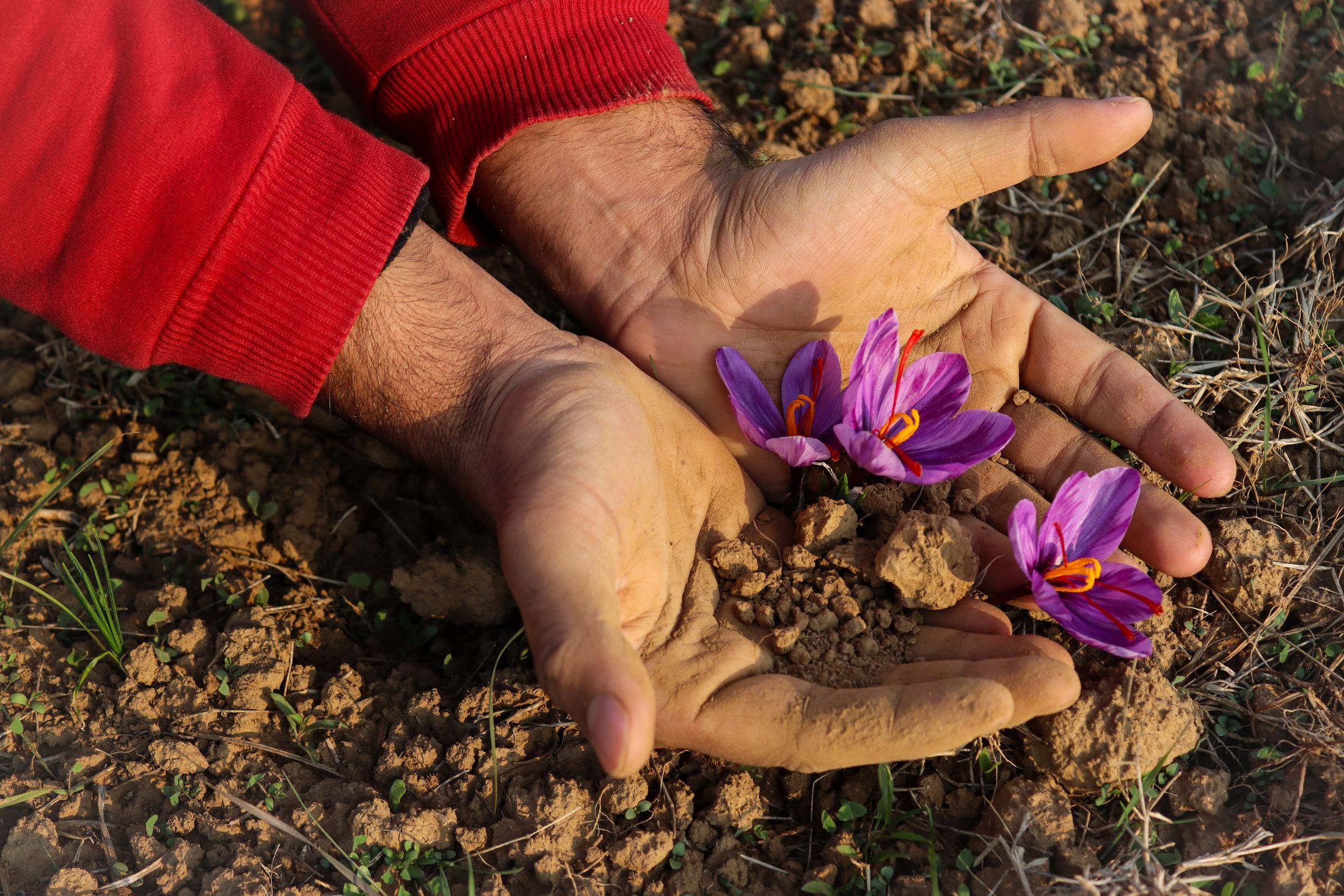
The Karewas are flat-topped plateaus of lacustrine sediment, laid down when a vast lake filled the Kashmir valley and then drained. The soil is deep, well drained and fine-textured, and the plateaus sit above the valley floor at the 1,600 to 1,800 metre band the GI specifies. The crocus corms are planted in late summer, and the plant flowers in a cold, dry autumn, usually across two to three weeks in October, before hard frost.
Why this produces strong saffron is partly understood and partly tradition, but the measurable result is consistent. ISO 3632 Category I requires a crocin reading (colouring strength at 440 nm) of 200 or more. The Pampore lots we have tested read between 230 and 270, and Kashmir-based sellers report similar 230 to 270 readings for genuine Mongra. We print that number on every vial, because it is the one figure that converts the GI’s promise into something you can check.
The flip side is fragility. The same cold, dry autumn that makes the saffron is what climate change is disrupting. Unseasonal rain during the 2025 flowering cut yields badly, and local press has reported global warming as a threat to the crop, with some growers warning that cultivation could fade by 2030 without new corms and irrigation. The GI zone is not movable. If saffron cannot be grown on the Karewas, there is no Kashmir saffron.
IIKSTC Pampore: GI tagging and the e-auction
The practical machinery behind the GI is the India International Kashmir Saffron Trading Centre (IIKSTC) at Pampore. It was built to give growers a single place to dry, grade, test, GI-tag and sell their saffron, instead of selling loose to traders. According to local reporting, the centre has 5,079 growers and 487 buyers registered on its e-auction portal.
Its stated purpose includes stopping the “adulteration and repacking of saffron from other countries” under the Kashmiri name. Saffron that passes through the centre is tested, graded and tagged, and buyers purchase identified lots. The wholesale prices quoted in the Indian press, including the record of about ₹3.25 lakh per kilogram in early 2026, are the centre’s auction prices.
For a buyer abroad, the centre matters in two ways. First, a seller who sources GI-tagged lots through the centre or directly from registered growers can show a chain from field to vial. Second, the centre’s own testing and the seller’s per-batch lab test corroborate each other. One without the other is weaker. We buy from registered growers, test each lot independently at an accredited lab, and publish the report; see the verify page for any lot code on our labels.
What the GI guarantees, and what it does not
It is worth being precise, because the GI is often sold to buyers as a guarantee of authenticity, and it is not quite that.
What the GI does guarantee. That the name Kashmir Saffron has a legal definition: a region, an altitude, a soil, three grades and a quality standard. That inside India, growers and the trading centre have a route to act against mislabelling. That a product carrying a legitimate GI tag was grown within the zone to the specification.
What it does not guarantee. That a pack sold in Dubai, London or New Jersey with “Kashmiri” on the front contains any Kashmir saffron at all. Customs officers and marketplace listing tools in those countries do not check Indian GI claims. The scale of the gap is visible in trade data: India exported only 15 tonnes of saffron in 2023 and is itself a net importer, while the UAE alone bought 29.7 tonnes of Iranian saffron in six months of 2025. Much of what is sold abroad as Kashmiri is Iranian saffron repacked.
The GI also says nothing about the specific lot in front of you. Saffron from the right field can still be stored badly, mixed with Lachha, or aged past its best.
How to see the GI on a pack
Look for four things on the label, in this order.
- The name and number. “Kashmir Saffron” with “GI No. 635” or “GI Registration 635”. A general “product of India” or “Kashmiri” with no number is not a GI claim.
- The grade. Mongra, Lachha or Guchhi. The GI covers all three; the price should match the grade.
- A GI tag or QR code. Saffron processed through the Pampore trading centre can carry a tag issued there. A seller who packs their own lots may instead print a QR that links to the lot’s report, which does the same job.
- A lot code, harvest date and lab values. These are not part of the GI, but they are what makes the GI claim checkable. On our vials you will find the lot code, crocin number, harvest month and year, and the grower’s name next to the GI number.
If a label has the GI number but no grade, no lot code and no date, the GI is doing decorative work.
Is Kashmiri saffron the best in the world?
The honest answer is that “best” depends on what you measure, but on two measures Kashmir’s case is strong.
On colouring strength, Mongra is among the highest-testing saffron sold anywhere; the 230 to 270 crocin readings above compare with the 200 minimum for Category I. On rarity, there is no contest: Jammu and Kashmir’s output over the last five years ran from 14.87 to 23.53 tonnes a year, against a world export trade worth $253 million in 2024 led by Iran at $95.5 million and Afghanistan at $60.4 million. Around 32,000 people in the valley work on a crop that would fit in a few shipping containers.
Buyers who pay for quality already treat it that way. Japan, which pays the highest average import price for saffron of any major market, paid about $3,000 per kilogram for the small quantity of Indian saffron it imported in 2024, nearly double its average across all origins. And in 2026, with conflict in West Asia and a weaker Iranian crop, demand for Kashmir saffron rose in the UAE, US and Europe.
None of that makes good Persian or Afghan super negin a bad buy. It makes Kashmiri Mongra a different product: the strongest-colouring, scarcest, most closely defined saffron there is, with a GI that says exactly what it should be and, from the right seller, a lab number that proves it.
Read next: How saffron is harvested in Pampore and Where to buy genuine Kashmiri saffron in the UAE, US, UK and Australia.
Questions people ask
What is the Kashmir saffron GI tag?
It is a Geographical Indication registered in India under number 635, granted in 2020, that reserves the name Kashmir Saffron for saffron grown in specified tehsils of Pulwama, Budgam, Srinagar and Kishtwar districts at 1,600 to 1,800 metres on Karewa soil. It covers three grades, Mongra, Lachha and Guchhi, and ties the name to a defined growing method and quality standard, so saffron from elsewhere cannot legally use it in India.
Does the GI tag guarantee my saffron is genuine?
Inside India, the GI gives growers and the trading centre a legal tool against mislabelling. Outside India it is much weaker: customs and marketplaces abroad do not check GI claims, so Iranian saffron can be sold as Kashmiri without consequence. The GI tells you what Kashmir saffron should be. A per-batch lab report with a lot code tells you whether the saffron in your hand actually is that. You need both.
Is Kashmiri saffron the best in the world?
On colouring strength, Kashmiri Mongra is among the strongest saffron measured: ISO 3632 Category I requires a crocin reading of 200, and Pampore lots we have tested read 230 to 270. It is also the scarcest, at roughly 20 tonnes a year against Iran's 90 percent share of world supply. Good Persian and Afghan super negin are excellent too. What is different is the combination of deep colour, aroma and rarity, and the price reflects it.
What does Pampore have to do with saffron?
Pampore, in Pulwama district about 15 kilometres from Srinagar, is the historic centre of Kashmir saffron growing and sits on the Karewa plateaus the GI specifies. It hosts the India International Kashmir Saffron Trading Centre, where GI-registered saffron is processed, tagged and sold by e-auction to registered buyers. When people say Pampore saffron, they mean Kashmir saffron from its core growing area.
How can I see the GI tag on a pack of saffron?
Look for the words Kashmir Saffron with the GI registration number 635, the grade name, and ideally a tag or QR code issued through the Pampore trading centre. On our vials the GI number sits alongside the lot code, crocin value, harvest date and grower's name, and the lot code links to the full lab report on our verify page. A pack that says Kashmiri but shows no GI number, grade or lot code is making a claim, not proving one.
Written by the Kashmiri Treasures team in Srinagar. We buy at the field in Pampore, test every lot to ISO 3632, and print the result on the vial. See who we are or verify a lot.