Visiting the Saffron Fields of Pampore: When to Go, What You Will See, and How to Buy Without Being Cheated
A visitor's guide to Pampore, Kashmir's saffron town: bloom dates, getting there from Srinagar, the villages, the shrine legend, field etiquette and buying on the spot.
By Kashmiri Treasures · October 31, 2026 · 6 min read
For about three weeks every autumn the flat, dun-coloured plateau south of Srinagar turns purple. The saffron crocus, Crocus sativus, flowers in late October and early November across the Karewa tablelands around Pampore, and for those weeks whole families are in the fields at first light picking flowers into wicker baskets before the sun opens them fully. By mid-November the flowers are gone, the stigmas are drying on cloth in upstairs rooms across the town, and the fields look like bare brown earth again until next year.
It is one of the most beautiful agricultural sights in India and one of the least visited, partly because the window is short and partly because Kashmir’s tourism season runs in summer. This guide is for anyone who wants to see it: when to go, how to get there, which villages, what you will see, how to behave in a working field, and how to buy saffron on the spot without being sold Iranian threads at Kashmiri prices.
When to go
The bloom usually begins in the last third of October and finishes in the first or second week of November. Warm, dry early autumns bring it forward; cold wet ones push it back and shorten it. If you can only pick one window, aim for 25 October to 5 November.
Go at dawn, or as close to it as you can manage. The flowers open overnight and pickers are in the fields from first light, so the purple is at its fullest before eight and a field can be largely picked by late morning. The light at that hour, low over the plateau with the Pir Panjal range behind, is also the reason every photograph you have seen of Pampore looks the way it does.
Weather in late October is crisp: daytime highs around 15 to 20°C, nights close to freezing, usually clear. Bring a warm layer for the early start and shoes you do not mind getting muddy.
Getting there
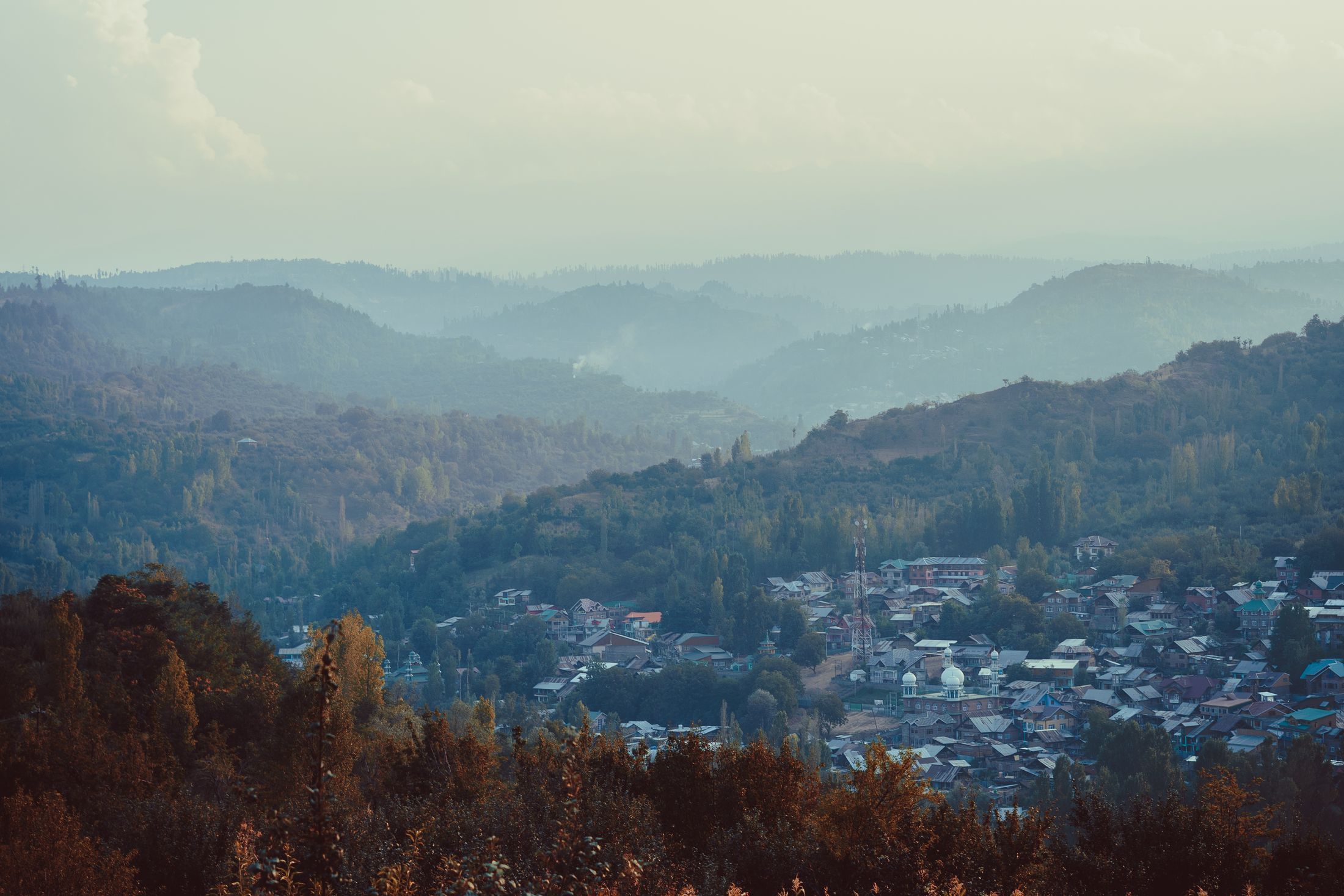
Pampore sits on National Highway 44, the Srinagar to Jammu road, about 15 kilometres south of Srinagar’s centre and roughly the same from Srinagar airport. A taxi from a Dal Lake houseboat or a city hotel takes 30 to 40 minutes. Any hotel will arrange a half-day car; agree the price first and ask for a driver who knows the saffron villages rather than just the highway.
The fields begin almost as soon as the road climbs onto the plateau after crossing the Jhelum. You will see them on both sides of the highway, which is why the roadside is lined with saffron shops. Resist stopping there; the better fields and the better saffron are a few minutes off the main road.
The villages
The saffron belt covers a cluster of villages on the plateau, each with its own fields and growing families:
- Lethpora, just off the highway, with some of the largest open fields and the easiest access.
- Dussu, home to the India International Kashmir Saffron Trading Centre, the government facility opened in 2020 where growers can have saffron graded and tested and which handles the GI certification.
- Konibal, Ladhoo, Chandhara, Khrew and Namblabal, the heart of the traditional growing area, with smaller fields and more family-scale growing.
You do not need a specific destination. Ask your driver to take the lanes behind Lethpora or towards Ladhoo and stop where the fields are purple and people are picking. Within a few minutes someone will ask where you are from.
What you will see
The plateau itself, the Karewa, is a raised bed of ancient lake sediment, well drained and poor in organic matter, which is exactly what the crocus likes. The fields are flat, unirrigated and unfenced, divided by low earth ridges. In bloom, each is a carpet of six-petalled lilac flowers a few centimetres high with three vivid red stigmas visible inside each one.
Picking is done by hand, usually by the whole family, often with hired help from neighbouring villages. The flowers are pinched off at the base and dropped into baskets or cloth bundles. Back at the house, usually that afternoon, the family sits in a circle separating the three red stigmas from each flower, trimming the pale yellow style, and spreading the red threads on cloth or sieves to dry in warm shade. About 150 flowers make a gram of dried saffron, so a basket that looks like a lot of flowers becomes a surprisingly small heap of threads.
If you are invited into a house to see the separation and drying, accept. This is where Mongra, the all-red top grade, is made, by hand, one stigma at a time. How saffron is harvested in Pampore describes the whole process from corm to vial.
The shrine and the legend
In the town itself is the shrine of Khwaja Masood Wali and Sheikh Sharifuddin Wali, two Sufi saints. The local legend is that in the twelfth century the saints, travelling through the valley, fell ill and were cured by a local chieftain, who was given a saffron corm in return, and that from this corm all Kashmiri saffron descends. Historians note that Kalhana’s Rajatarangini, the twelfth-century chronicle of Kashmir’s kings, already treats saffron as an established crop, and that the plant has probably been grown in the valley for over two thousand years. Both stories are told in Pampore, and growers still offer the first flowers of the season at the shrine. The history of saffron follows the spice from Minoan Crete to Kashmir.
Buying saffron in Pampore
The best saffron in the world is sold here, and so is a great deal that is not Kashmiri at all. The highway shops in particular trade heavily in Iranian saffron relabelled as Kashmiri, in lower Lacha grades sold as Mongra, and occasionally in dyed safflower. Prices are what tell the story: genuine Kashmiri Mongra has a wholesale price at the Pampore trading centre that moves between roughly ₹2 and ₹3.5 lakh per kilogram depending on the season, so anyone offering you Mongra at ₹100 a gram is not selling Mongra.
How to buy well:
- Buy from a grower family you have met, at their house, rather than at a roadside stall.
- Ask for Mongra and look at it. All-red threads with flared tips and no yellow base. If you see pale style attached, it is Lacha; good, but should be cheaper.
- Do the water test if the family will let you: a few threads in warm water should release colour slowly over several minutes while staying red themselves.
- Ask when it was picked. The honest answer in late October is this week.
- Expect to pay a real price. At the field in a normal year, a gram of fresh Mongra direct from a grower costs several hundred rupees. Much below that, be suspicious.
- Carry cash. Few families take cards; UPI is increasingly common.
Saffron bought this way travels well. Keep it in the small plastic or glass container it comes in, out of light, and decant into an airtight glass vial at home; how to store saffron has the rules. Most countries allow a few grams of saffron for personal use in your luggage; it is a dried spice, not a plant, and declares easily.
If you cannot make the trip
The season is short, the valley is far, and most of our customers will never stand in a Pampore field at dawn. What we try to do is bring the field to the vial: we buy from named growers in these villages each October, have each lot tested to ISO 3632, and print the lot code, the colouring strength, the harvest month and the grower’s name on the label. You can read the lot report on the verify page and see the current lot on the saffron page.
Read next: How saffron is harvested in Pampore and Kashmir saffron GI tag explained.
Questions people ask
When is the best time to visit the saffron fields in Pampore?
The last ten days of October and the first week of November. The crocus blooms for roughly two to three weeks and the exact start moves with the weather, but 25 October to 5 November catches the peak in most years. Go at dawn: flowers open overnight and are picked early, so by midday a field that was purple at seven can be mostly bare.
Where is Pampore and how do I get there?
Pampore is a town in Pulwama district about 15 km south of Srinagar on the Srinagar to Jammu highway, roughly 30 to 40 minutes by taxi from the city or 20 minutes from Srinagar airport. Any Srinagar hotel or houseboat can arrange a car for a half day. The fields are on the flat Karewa plateau either side of the highway and around the villages of Lethpora, Konibal, Dussu, Ladhoo, Khrew and Chandhara.
Can I pick saffron flowers myself?
Only if a grower invites you to, which many will if you ask politely and show interest. The fields are private family land and the flowers are the year's income. Do not walk into a field uninvited, do not pick anything, and ask before photographing people. A small purchase from the family afterwards is the right way to say thank you.
Is it safe to buy saffron in Pampore?
Buying directly from a grower family at their home is usually safe and is the best saffron you will find anywhere. Buying from roadside stalls and highway shops is riskier: much of what is sold there is Iranian saffron or lower grades sold as Mongra, and some is fake. Insist on seeing whole threads, do the water test if you can, ask for a GI logo and lot number, and expect to pay a genuine Kashmiri price.
Is there a saffron festival in Kashmir?
Jammu and Kashmir's tourism department has held saffron festivals in Pampore during the bloom in recent years, with field visits, stalls and cultural programmes. Dates are announced close to the season and have varied, so check with J&K Tourism before you travel rather than planning around a fixed date.
Written by the Kashmiri Treasures team in Srinagar. We buy at the field in Pampore, test every lot to ISO 3632, and print the result on the vial. See who we are or verify a lot.