The History of Saffron: From Minoan Frescoes to the Fields of Kashmir
A 3,500-year history of saffron: Bronze Age Greece and the Minoans, Persia and Kashmir, the medieval trade and its frauds, Spain and England, and today's growers.
By Kashmiri Treasures · October 31, 2026 · 7 min read
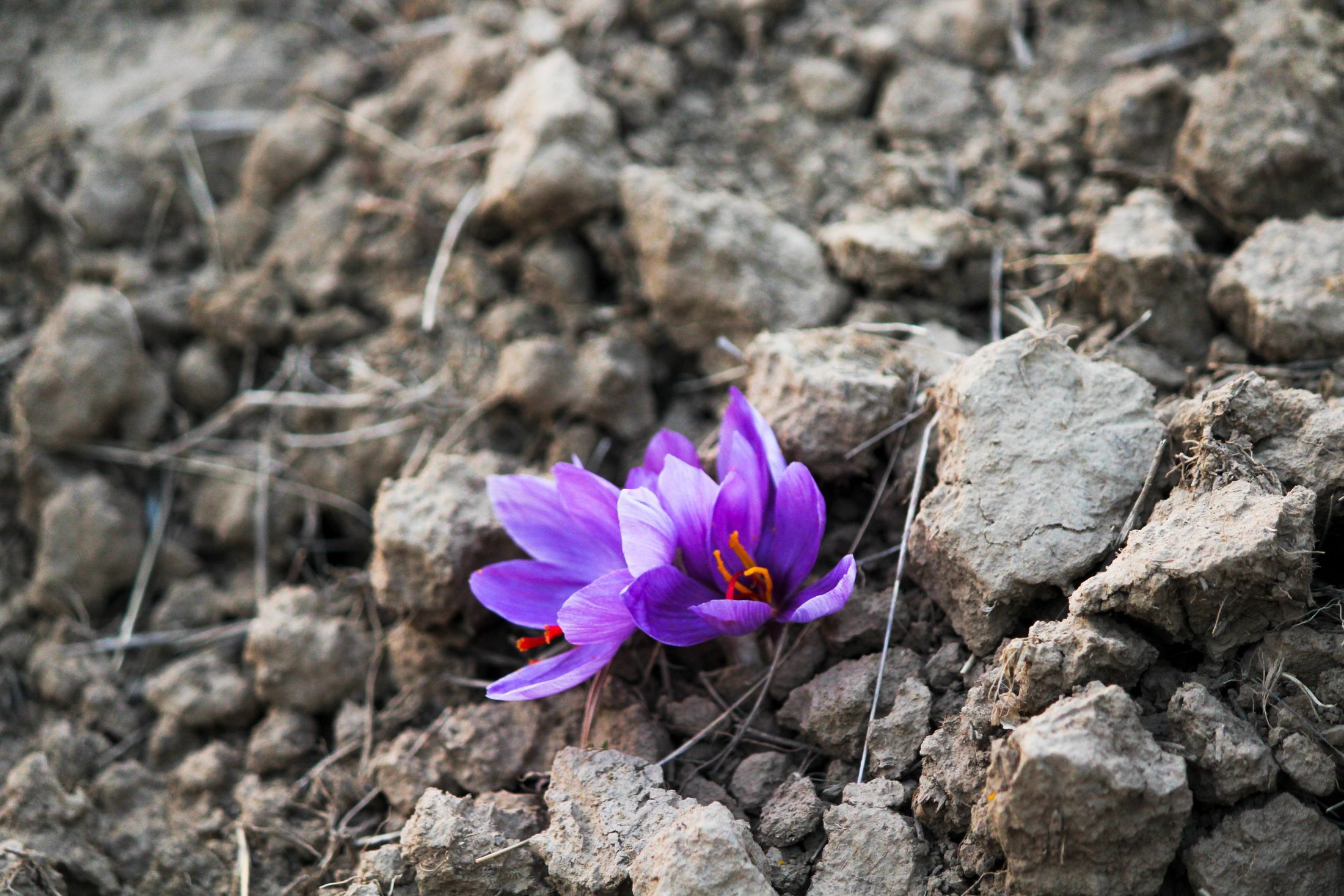
Saffron is older than written history in Europe. On the island of Santorini, under the volcanic ash that buried the Minoan town of Akrotiri around 1600 BCE, archaeologists uncovered a fresco of young women in a rocky landscape picking crocus flowers and gathering the red stigmas into baskets, while another presents them to a seated goddess. The flowers are unmistakably saffron crocus. Three and a half thousand years later, in the villages around Pampore, families are doing the same thing with the same plant.
That continuity is possible because of a botanical accident. Crocus sativus is a sterile triploid: it has three sets of chromosomes, cannot set seed, and can only be propagated by dividing its corms. Every saffron plant alive today is, in effect, a cutting of a cutting of a cutting of the first plants selected by Bronze Age farmers. Saffron has never been reinvented. It has only been carried.
This is the story of where it was carried, by whom, and why it came to rest in the places that grow it now.
Origins: the Aegean, about 1500 BCE
Genetic studies in the last decade have largely settled the question of saffron’s parentage. Its wild ancestor is Crocus cartwrightianus, a species native to Greece and Crete, and the saffron crocus most likely arose when a farmer noticed a plant with abnormally long, deeply coloured stigmas and kept it going by corm division. Whether this happened once or several times, and exactly where, is still debated, but the Aegean in the Bronze Age is the consensus.
The Minoans clearly prized it. Beyond the Akrotiri frescoes, crocus flowers appear on Minoan pottery, in the Knossos palace frescoes and in Linear B tablets, where saffron seems to have been recorded as a commodity. It was used as a dye, a perfume, a medicine and an offering.
The ancient Near East and Egypt
From the Aegean saffron moved east and south. An Assyrian botanical compilation attributed to the library of Ashurbanipal in seventh-century BCE Nineveh lists saffron among medicinal plants. In Persia, saffron was woven into royal carpets and shrouds, used as a dye, offered to the gods and, according to Greek writers, dissolved in warm tea and strewn in baths and bedding. Persian saffron, grown in what is now Khorasan, was already a major crop under the Achaemenids, and Persia is the one place where cultivation has probably never been interrupted since.
Egypt knew it too. The Ebers Papyrus, a medical text of around 1550 BCE, is often said to mention saffron, and later Ptolemaic Egypt certainly used it as a perfume and cosmetic. The story that Cleopatra bathed in saffron-infused mare’s milk before meeting lovers comes from much later writers and is best filed as legend. Saffron was expensive enough for the legend to make sense.
Rome and the Mediterranean
Greeks and Romans used saffron lavishly: as a perfume strewn in theatres and public halls, as a dye for the robes of the wealthy, as a medicine for everything from indigestion to melancholy, and in the kitchen. Pliny the Elder complained about its adulteration, which tells you it was valuable and traded widely. Roman colonists probably took saffron cultivation to southern Gaul, and when the Western Empire fell in the fifth century European saffron growing went with it, not to return for several hundred years.
Kashmir and the east
Saffron reached Kashmir in antiquity, though the exact route is unclear. The valley’s own tradition holds that Persian settlers brought the corm around 500 BCE. Whatever the date, by the twelfth century the historian Kalhana, writing the Rajatarangini, his chronicle of Kashmir’s kings, treated saffron as a well-established crop of the valley, and Chinese medical texts of the period described saffron as a product of Kashmir, reaching China via Tibet, where it was called the Tibetan red flower.
Pampore has its own story. The shrine in the town honours two Sufi saints, Khwaja Masood Wali and Sheikh Sharifuddin Wali, said to have arrived in the twelfth century, fallen ill, been cured by a local chieftain and repaid him with a saffron corm. Growers still bring the first flowers of the season to the shrine. The legend postdates the earlier evidence, but it captures something true: in Kashmir saffron has always been as much devotional as commercial, and Kashmiri saffron has always been grown on the same few square kilometres of Karewa plateau south of Srinagar. Visiting the saffron fields of Pampore describes what that looks like today.
In India more broadly, saffron, as kesar or kumkuma, entered Ayurvedic medicine, Hindu ritual and the cooking of every court that could afford it. Under the Mughals it became indispensable to the cuisine of Delhi, Lucknow and Hyderabad, which is where zafrani pulao and saffron biryani come from. Kesar vs saffron traces the names.
The medieval saffron trade
Saffron returned to Europe with the Arab expansion. The Moors brought it to Spain in the eighth and ninth centuries, where La Mancha’s dry plateau proved ideal, and from there and from the Levant via Venice and Genoa it spread north as a luxury good.
By the fourteenth century demand in Europe was enormous. Saffron was used against the Black Death, as a dye for cloth and the gold of illuminated manuscripts, and in the cooking of the rich, where yellow food signalled wealth. The trade was lucrative enough to fight over. In 1374 a shipment of some 360 kilograms bound for Basel was seized by nobles, and the fourteen-week dispute that followed is remembered as the Saffron War. Basel itself grew saffron for a time afterwards.
Nuremberg became the centre of the trade and of its regulation. The Safranschou code of the fifteenth century prescribed heavy punishments for adulterating saffron, and the records show at least two traders were burned alive and others buried alive with their adulterated goods. The motive is familiar to anyone who buys saffron now: at those prices, cutting it with safflower, marigold or dyed fibres was irresistible, and it took the threat of execution to deter it. We still have the same problem with gentler remedies; how to spot fake saffron is the modern Safranschou.
England and Saffron Walden
Saffron was grown in England from the fourteenth to the eighteenth centuries, chiefly in Essex and Cambridgeshire. The Essex town of Chepyng Walden became so identified with the crop that it renamed itself Saffron Walden and put crocus flowers on its arms. Local legend has a pilgrim smuggling a single corm home from the Levant in a hollowed staff. English saffron was prized for its quality, used in Cornish saffron buns, in medicine and as a dye, and died out in the eighteenth century as cheaper imports and new dyes arrived. Cornish saffron cake survives as its monument.
Spain, Italy, Pennsylvania
Spain remained Europe’s great producer for centuries, with La Mancha saffron, toasted as part of drying, becoming the reference for paella and much Spanish cooking. Italy’s saffron, in Abruzzo and Sardinia, came with the Moors and the Spanish and gave the world risotto alla Milanese. German-speaking settlers carried saffron to Pennsylvania in the eighteenth century, where it became a quiet tradition of Pennsylvania Dutch cooking and is still grown in Lancaster County in tiny quantities.
Through all of this, Persia kept growing saffron at a scale no one else matched, and Kashmir kept growing a small quantity of a very particular kind.
The modern map
Today Iran produces roughly 90 percent of the world’s saffron, nearly all from Khorasan, where hundreds of thousands of smallholders grow it on dry land that supports little else. Afghanistan has expanded rapidly since the 2000s as an alternative to opium poppy. Spain’s production has shrunk to a few tonnes, Greece’s Kozani cooperative and Italy’s Abruzzo and Sardinia make small, high-quality amounts, and Morocco’s Taliouine is a growing name.
Kashmir produces only a few tonnes a year, from fields that have been shrinking under urbanisation, drought and the Srinagar highway for decades. In 2020 the Government of India granted Kashmir Saffron Geographical Indication No. 635, protecting the name and setting standards for what can carry it, and a trading and testing centre opened at Dussu in Pampore to grade and certify it. Whether the crop recovers depends on water, on young people choosing to stay in the villages, and on buyers paying a price that reflects what Mongra actually is. The Kashmir saffron GI tag explained covers what the protection means when you buy.
The plant itself has not changed. Three red stigmas, picked at dawn, separated by hand, dried in shade: the Minoan women at Akrotiri would recognise every step.
Read next: How saffron is harvested in Pampore and Kashmiri vs Persian vs Spanish saffron.
Questions people ask
Where does saffron originally come from?
Saffron was almost certainly domesticated in the Bronze Age Aegean, in Crete or mainland Greece, roughly 3,500 years ago. Genetic work points to its wild ancestor being Crocus cartwrightianus, a species still found in Greece. The saffron crocus is a sterile triploid that cannot set seed, so every plant alive today descends by corm division from those first selections, carried east to Persia and Kashmir and west to Spain over the following centuries.
How old is saffron cultivation in Kashmir?
At least two thousand years, and probably longer. Kashmiri tradition dates it to the arrival of Persian settlers around 500 BCE. The twelfth-century chronicle Rajatarangini treats saffron as an established crop, and Chinese medical texts from the same period describe saffron as coming from Kashmir. The local legend that two Sufi saints brought the first corm in the twelfth century is cherished in Pampore but postdates the earlier evidence.
Why was saffron so valuable in the Middle Ages?
It was a dye, a medicine and a spice at once, it could only be grown in a few places, and it took around 150 flowers to make a gram. In medieval Europe it was used against plague, as a yellow dye for cloth and illuminated manuscripts, and in cooking for the wealthy. Prices were high enough that adulteration was punished by death in Nuremberg and that a dispute over a shipment sparked the Saffron War near Basel in 1374.
Why does Iran grow most of the world's saffron?
Iran has the climate, the land, the labour and a continuous tradition going back to the Achaemenid era. Khorasan province in the north-east has dry summers, cold winters and a long autumn, and saffron is grown there at scale by hundreds of thousands of smallholders. Iran produces roughly 90 percent of world supply. Kashmir, Spain, Greece, Afghanistan, Morocco and Italy make up most of the rest.
Who discovered saffron?
Nobody in particular. Saffron was selected from a wild crocus by Bronze Age farmers who noticed that some plants had unusually long, fragrant stigmas and propagated them. The Minoan frescoes at Akrotiri on Santorini, painted around 1600 BCE, already show women gathering saffron and offering it to a goddess, which means its value was established well before written history.
Written by the Kashmiri Treasures team in Srinagar. We buy at the field in Pampore, test every lot to ISO 3632, and print the result on the vial. See who we are or verify a lot.