Saffron vs Turmeric: Why They Are Not Substitutes (and When Each One Wins)
Saffron vs turmeric explained: different plants, pigments, flavours and prices, and why neither replaces the other. Plus honest substitutes when you have none.
By Kashmiri Treasures · October 7, 2026 · 10 min read
Saffron and turmeric are not the same spice, not related plants, and not substitutes for each other. Saffron is the dried red stigma of a crocus flower, picked by hand three threads at a time. Turmeric is a ground root from the ginger family, grown by the tonne. They both colour food yellow, and that is where the resemblance ends. Their pigments are chemically different, their flavours are opposites, and a gram of good saffron costs more than a whole jar of turmeric.
The confusion is old. Turmeric has been called “Indian saffron” in European trade for centuries, and “poor man’s saffron” gets attached to turmeric, safflower and marigold depending on who is talking. Recipes that say “saffron or turmeric” as if they were interchangeable have not helped.
We grow, test and sell Kashmir saffron, so we are not neutral, but we cook with turmeric every day too. This guide lays out the real differences, where each spice wins, and what to use if you genuinely have no saffron in the house.
Saffron vs turmeric at a glance
| Saffron | Turmeric | |
|---|---|---|
| Plant | Crocus sativus, a flowering crocus in the iris family | Curcuma longa, a rhizome plant in the ginger family |
| Part used | The three red stigmas of each flower, dried | The underground rhizome, boiled, dried and ground |
| Harvest | Hand-picked at dawn during a two-to-three-week autumn bloom | Dug up after eight to ten months; processed mechanically |
| Colour pigment | Crocin, a water-soluble carotenoid | Curcumin, a fat-soluble polyphenol |
| Colour in food | Golden yellow to deep amber, clear and glowing | Opaque mustard yellow, turning orange in quantity |
| Flavour | Bitter, floral, honeyed, with a hay-like aroma | Earthy, musky, slightly bitter and peppery |
| Aroma compound | Safranal, found only in saffron | Turmerone and related oils |
| Form sold | Whole threads (or powder, which we avoid) | Ground powder, or fresh root |
| Typical dose | A pinch of threads, about 10 to 20, for a dish serving four | Half to one teaspoon or more |
| 2026 retail price | About USD 5 to 21 per gram depending on origin | A supermarket jar costs less than one gram of good saffron |
| Signature dishes | Kahwa, biryani, risotto alla Milanese, paella, kheer, saffron milk | Curries, dals, golden milk, pickles, rice colouring |
Botany: a flower stigma vs a root
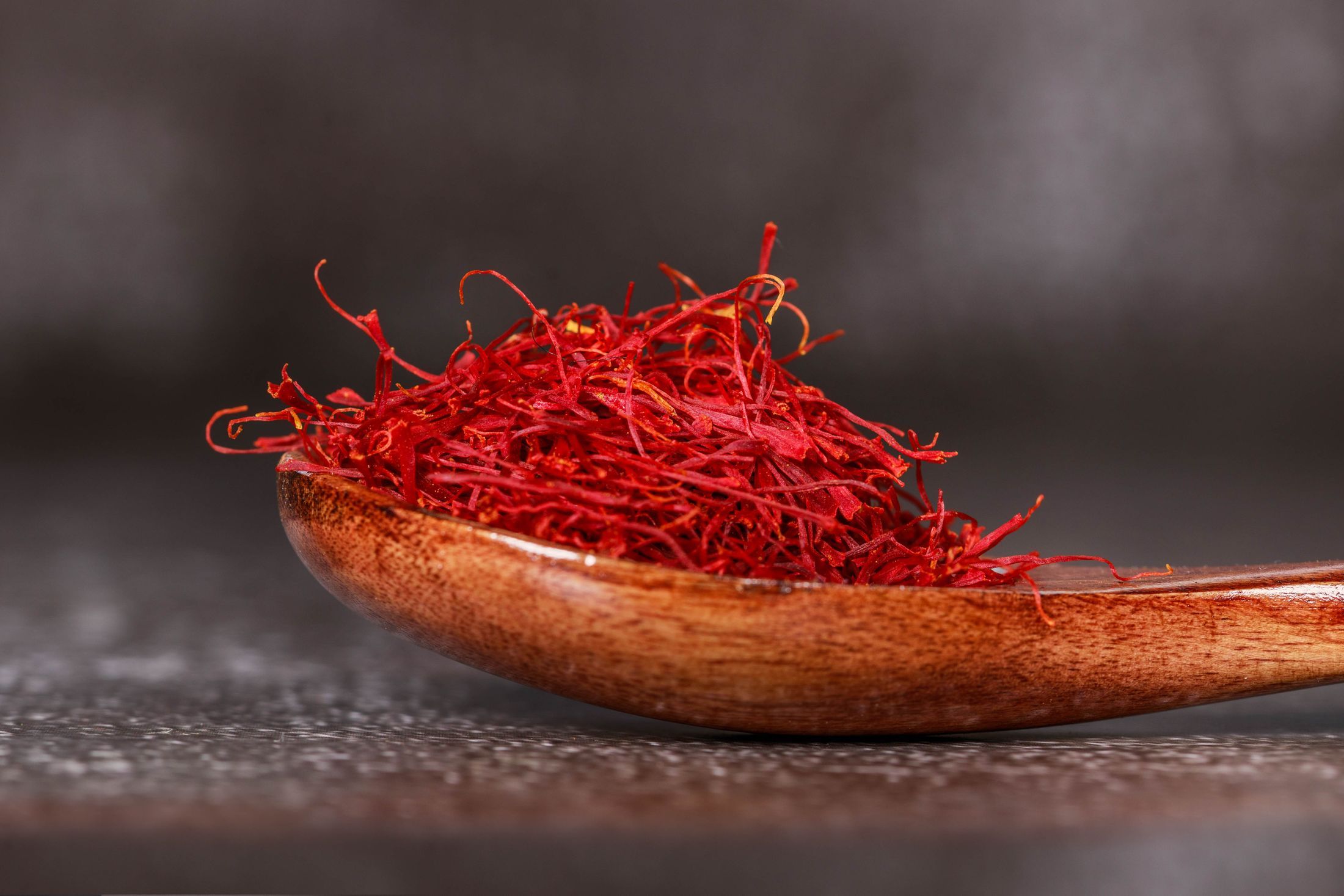
Saffron comes from Crocus sativus, a sterile autumn-flowering crocus propagated only by dividing its corms. Each purple flower produces exactly three red stigmas, the female part that would catch pollen. Those stigmas are the spice. In Pampore, pickers gather the flowers at dawn in October and separate the stigmas by hand the same day. Three stigmas per flower, hundreds of flowers to a gram of dried Mongra: that is the arithmetic behind the price. The whole of Jammu and Kashmir produced 19.58 tonnes in 2024-25, according to Outlook Business. You can see the harvest in how saffron is harvested in Pampore.
Turmeric comes from Curcuma longa, a leafy tropical plant related to ginger. The spice is the rhizome, the knobbly underground stem, dug up after most of a year, boiled, dried and ground. A single plant yields a fistful of rhizomes. Turmeric is a staple commodity; saffron is a luxury.
Colour chemistry: crocin vs curcumin
Both spices colour food yellow, but through different molecules that behave differently in the pan.
Crocin, saffron’s pigment, is a carotenoid that dissolves in water. That is why saffron is bloomed in warm water, milk or stock: the crocin leaves the thread and spreads evenly through the liquid, giving a clear, glowing gold that deepens to amber with more threads. In an ISO 3632 lab test, crocin is measured as colouring strength at 440 nm, and Category I saffron must read 200 or above. Sellers of Kashmiri Mongra, including us, report readings of 230 to 270 for good Pampore lots, and we print the number for each lot on the vial. The colour is clean and translucent, which is why saffron rice looks lit from within.
Curcumin, turmeric’s pigment, is a polyphenol that dissolves in fat rather than water. It gives an opaque, matte mustard yellow that turns orange as you add more, and it blooms best in oil or ghee at the start of cooking. It also stains wooden spoons and countertops far more stubbornly than saffron.
So turmeric in water gives a cloudy yellow suspension; saffron gives a clear golden solution. Put them side by side in two glasses and you will never confuse them again. This is the basis of the saffron water test in how to spot fake saffron, and why saffron powder cut with turmeric fails it: the water goes cloudy and orange instead of clear and gold.
Flavour and aroma: the real reason they are not substitutes
Colour is the least of it. The reason you cannot swap turmeric for saffron is taste.
Saffron tastes bitter first, from picrocrocin, then floral and honeyed, with an aroma of sweet hay and dried roses that comes from safranal. Safranal is unique to saffron; no other kitchen ingredient contains it. That aroma is what people mean when they say a dish “tastes of saffron.” Used correctly, a small pinch perfumes a whole pot of rice without tasting of anything you could name.
Turmeric tastes earthy, musky and a little peppery, with a bitterness that becomes medicinal in quantity. It is a background spice, the base note of a curry powder, and wonderful in that role. It has no floral quality, no honey, no hay. A teaspoon of turmeric in a risotto alla Milanese gives yellow risotto that tastes faintly of mustard. In kahwa it ruins the kahwa.
The reverse is also true. Saffron does not do turmeric’s job. A dal made with saffron instead of turmeric would be expensive, oddly perfumed and wrong.
Price: why one is sold by the gram and the other by the jar
Saffron is expensive because of labour and scarcity. Each flower gives three stigmas, the bloom lasts two to three weeks, and everything is done by hand. On the research date for our market notes, international retail prices per gram were roughly: Kashmiri Mongra USD 18 to 21, Afghan Super Negin 10 to 16, Persian Super Negin 5 to 10, Spanish Coupe about 7 to 14. The Alibaba spice guide warns that saffron listed under about USD 8 per gram is likely adulterated or mislabelled. Our full breakdown is in saffron price per gram.
Turmeric is a high-yield commodity crop, processed by machine, and a supermarket jar of ground turmeric costs less than a single gram of good saffron. That gap is exactly why turmeric is the most common thing used to cut saffron powder. It is the right colour, it is nearly free, and in a sealed jar of powder nobody can see it.
The lesson for buyers is simple: never buy saffron powder unless you ground it yourself. Whole threads cannot hide turmeric. For the same reason, we sell Mongra threads only, with the lot code and crocin number on the vial and the lab report on our verify page.
When turmeric wins and when saffron wins
Turmeric wins here
Turmeric is the better choice, and saffron the wrong one, in a long list of dishes:
- Curries, dals and sabzis where turmeric is the base note the other spices build on.
- Golden milk and turmeric lattes, which are about turmeric’s earthiness and a warming, slightly bitter finish.
- Pickles, marinades and rubs where you want colour plus a savoury depth that stands up to chilli and garlic.
- Everyday yellow rice for a weeknight, where a pinch of turmeric does the job and nobody is tasting for aroma.
- Anything cooked in quantity on a budget. Turmeric is cheap enough to use by the teaspoon; saffron is not.
In all of these, saffron would be wasted at best and unpleasant at worst.
Saffron wins here
Saffron is the only choice when the dish is about saffron:
- Kashmiri kahwa, where threads bloom in the pot with green tea, cardamom and almonds. Turmeric would taste medicinal. See our kahwa recipe.
- Biryani, pulao, Persian tahdig and risotto alla Milanese, where the perfume of saffron in the rice is the point. Our saffron rice guide covers all three styles.
- Paella, traditionally made with Spanish Coupe.
- Milk-based desserts: kheer, phirni, shrikhand, saffron ice cream, Swedish Lucia buns.
- Saffron milk or saffron water taken as a daily ritual, where the dose is a few threads and the aroma is half the pleasure.
In each of these the amount is small, about 10 to 20 threads for a dish serving four, bloomed first in a few spoonfuls of warm liquid. How to use saffron explains the technique. A gram, used this way, lasts a long time, which narrows the price gap more than the per-gram figure suggests.
Health context, briefly and honestly
Both spices have a long history in traditional medicine and a growing body of research, and both are oversold online. We will keep this short.
Saffron has been studied mostly for mood and attention. A systematic review of four trials covering 118 patients, summarised by EBSCO and covered by Healthline, found saffron comparable to methylphenidate for ADHD symptoms as a monotherapy and helpful as an add-on. Those are small, short trials, mostly using standardised extracts rather than kitchen threads, and they are not a reason to stop prescribed medication. Our summary of what the research says goes through the evidence study by study, and saffron safety in pregnancy, for kids and with medication covers the cautions.
Turmeric, through curcumin, has been studied largely for inflammation and joint comfort. The recurring limitation is that curcumin is poorly absorbed on its own, which is why supplements add black pepper extract or special formulations, and why trial results vary. Culinary amounts are safe for almost everyone; concentrated supplements can interact with blood thinners.
Neither spice is a treatment. If you are pregnant, on medication, or considering either in more than culinary amounts, ask a doctor first.
The “poor man’s saffron” myth
The phrase gets attached to three different things, and it is worth untangling them.
Turmeric was called “Indian saffron” by European traders because it was the cheap yellow spice from India. The name stuck in some languages and still causes confusion in translation.
Safflower (Carthamus tinctorius) is the plant most often meant by “poor man’s saffron,” and also by “Mexican saffron,” “American saffron” and, in the Philippines, “kasubha.” Its dried orange-red florets look a little like saffron threads and give a mild golden colour in water, with almost no flavour. Safflower is honest under its own name and a fraud when sold as saffron, which happens constantly; it is the number one fake we see.
Marigold petals (calendula) are sometimes dried and dyed to pass as saffron, and are occasionally called “poor man’s saffron” too.
None of these is poor man’s anything in a useful sense, because none of them does what saffron does. They colour. They do not perfume.
Honest saffron substitutes, and what each one cannot do
If a recipe calls for saffron and you have none, here is what actually works, ranked by how close it gets.
- Safflower petals. Best for colour in rice, soups and broths. A generous pinch, steeped like saffron, gives a soft gold. Zero aroma, slight hay note. Do not expect anyone to think it is saffron.
- Annatto (achiote). Seeds or paste give an orange-red colour, especially in oil. Mild, peppery, slightly earthy flavour. Good in Latin rice dishes and stews; wrong in desserts and tea.
- A pinch of turmeric with a little sweet paprika. The turmeric gives yellow, the paprika warms it toward saffron’s amber. Use far less than you think: a quarter teaspoon of turmeric for a pot of rice. Earthy flavour, no perfume. Acceptable for weeknight yellow rice.
- Turmeric alone. Colour only, with an earthy taste. The last resort for rice; never for milk, tea or desserts.
- Marigold or calendula petals. Faint colour, faint flavour. Mostly decorative.
What none of them can do is replace safranal. If the dish is kahwa, saffron milk, kheer, risotto alla Milanese or a biryani for guests, the honest advice is to buy a small amount of real saffron, bloom it properly and use it sparingly. Half a gram is enough for several such dishes.
If only saffron will do, three rules keep you safe. Buy whole threads, never powder, so nothing can be hidden. Buy from a seller who publishes an ISO 3632 report for your batch, with the batch code on the pack and the crocin number where you can see it. And buy from a seller who will refund you if an independent lab disagrees; we refund double. Our Mongra, with this season’s lot number, grower name and harvest date on the vial, is on our saffron page, and the questions we are asked most are answered on our FAQ.
Read next
To see how saffron origins differ from each other, read Kashmiri vs Persian vs Spanish Saffron: Colour, Aroma, Price and Which to Buy. To get the most out of a small amount, read How to Use Saffron, which covers blooming, amounts and storage.
Questions people ask
Is turmeric the same as saffron?
No. Saffron is the dried red stigma of the Crocus sativus flower, picked by hand and sold by the gram. Turmeric is the boiled, dried and ground rhizome, an underground stem, of Curcuma longa, a plant in the ginger family, sold by the hundred grams. They share nothing but a yellow tint in food. Their pigments, flavours, aromas, uses and prices are all different, and one cannot be passed off as the other once you taste it.
Can I use turmeric instead of saffron?
Only for colour, and only in dishes where flavour does not depend on saffron. A pinch of turmeric will turn rice yellow, but it adds an earthy, slightly bitter, mustard-like taste and none of saffron's honey and hay aroma. Use a very small amount, since too much turns food orange and medicinal. For dishes where saffron is the point, such as kahwa, saffron milk, risotto alla Milanese or biryani, there is no substitute.
Why is saffron so much more expensive than turmeric?
Saffron is three stigmas per flower, picked at dawn during a bloom that lasts two to three weeks each October, then trimmed by hand. The whole of Jammu and Kashmir produced about 19.58 tonnes in 2024-25. Turmeric is a rhizome crop grown in the tonnes per hectare and processed by machine. Retail saffron runs from about USD 5 to 21 per gram depending on origin; a supermarket jar of ground turmeric costs less than a single gram of good saffron.
What is the best substitute for saffron?
For colour alone, safflower petals, sometimes sold as Mexican saffron, give a gentle golden tint without a strong taste. Annatto gives an orange-red hue in rice and stews. A small pinch of turmeric with a little sweet paprika gets close to saffron's colour in rice. None of these reproduces saffron's aroma, which comes from safranal, a compound found only in saffron. If the recipe is about saffron, buy a small amount of real saffron instead.
Is saffron or turmeric healthier?
They are studied for different things. Saffron research has focused on mood and attention; one systematic review of four small trials found saffron comparable to methylphenidate for ADHD symptoms, though the trials were short and small. Turmeric's curcumin is widely studied for inflammation, with poor absorption a recurring limitation. Neither replaces medical treatment. Talk to a doctor before using either in larger than culinary amounts, especially in pregnancy or alongside medication.
Written by the Kashmiri Treasures team in Srinagar. We buy at the field in Pampore, test every lot to ISO 3632, and print the result on the vial. See who we are or verify a lot.