Where to Buy Genuine Kashmiri Saffron in the UAE, US, UK and Australia (and How to Check It Is Real)
Where to buy Kashmiri saffron in the UAE, US, UK, Australia and Canada: every channel compared, local prices, duties and a 7-point check before you pay.
By Kashmiri Treasures · October 7, 2026 · 10 min read
You can buy Kashmiri saffron in four kinds of place: direct from a seller at origin in Kashmir, from a US or UK curated spice brand, from a marketplace such as Amazon, Walmart or eBay, or over the counter at an Indian, Pakistani or Persian grocer. Each has real advantages. Only the first lets you trace a vial back to a named field and a lab report, and that matters more for Kashmiri saffron than for any other origin.
The reason is supply. Kashmir produced 19.58 tonnes of saffron in 2024 to 2025, while Iran produces about 90 percent of the world’s supply. India as a whole is a net importer of saffron, ranking second in the world by import value in 2024 and only fifteenth as an exporter. Very little saffron sold abroad under a Kashmiri label can have come from Kashmir, so the label alone proves nothing.
This guide compares the channels honestly, walks through what to expect in the UAE, Saudi Arabia, the US, the UK, Australia and Canada, and gives you a seven-point check to run before you pay. We buy at the field in Pampore, so we have a view, but the checklist works whoever you buy from.
The four ways to buy Kashmiri saffron, compared
| Channel | What is good about it | What to watch |
|---|---|---|
| Direct from origin (Kashmir-based sellers, including us) | Freshest crop, lot-level traceability, GI number on pack, lowest price per gram for genuine Mongra | Some sellers have paused international shipping or leave customs duties to the buyer; small review counts; delivery by post can be slow |
| US and UK curated spice brands | Polished service, fast domestic delivery, organic and ethical sourcing claims, strong reviews | $18 to $21 per gram, usually a single 1 g size, no per-batch lab numbers published, rarely ship outside their home country |
| Marketplaces (Amazon, Walmart, eBay) | Convenient, returns handled, many sellers | Star ratings are unreliable, repacked Iranian saffron common, harvest date and lab report rarely shown |
| Indian, Pakistani and Persian grocers, spice shops | You can see the threads, no shipping wait, good for Lachha and Persian grades | Origin claims are hard to verify, “Kashmiri” often means Iranian, cross-border re-shippers can charge $38 to $43 per gram for a branded Indian 1 g pack |
A few details behind that table. The two best-known US sellers of Kashmiri saffron charge $18 and $20.99 for 1 g, publish harvest dates and say their saffron is lab-tested, but do not print the crocin value for each batch. Several Kashmir-based sellers list Mongra at the equivalent of $5 to $10 per gram, but one marks international orders as “temporarily paused” and states that customers are responsible for customs duties. On marketplaces, Amazon has had to sue review-selling sites over fake verified reviews, and Jammu and Kashmir authorities have previously forced Amazon to stop selling fake Kashmir pashmina. Saffron is at least as easy to mislabel.
The repacking problem
Most “Kashmiri” saffron sold abroad is Iranian saffron that has been repacked, and it is worth being clear that this is not necessarily bad saffron. Iranian super negin is good saffron at a fair price of $5 to $10 per gram. The problem is paying Kashmiri prices for it.
The numbers make the scale obvious. The UAE alone bought 29.7 tonnes of Iranian saffron in six months of 2025, more than Kashmir grows in a year. The UK’s saffron imports come mainly from Spain and Iran, and the US imports about 83 percent of its saffron from Spain, itself largely a packer of Iranian and Afghan crop. Kashmir’s own export was 15 tonnes in 2023, going mostly to the UAE, US, Australia, Saudi Arabia and the UK.
The GI registration (No. 635) protects the name “Kashmir Saffron” in India, and the trading centre in Pampore was set up specifically to stop repacking of saffron from other countries under the Kashmiri name. But the GI cannot follow a parcel across a border. The only check that travels with the saffron is a lab report tied to a lot code, which is why we print both on the vial. We go deeper on this in Kashmir saffron GI tag explained.
Buying Kashmiri saffron in the UAE and Saudi Arabia
If you search for Kashmiri saffron from Dubai, Google’s first suggestion is “kashmiri saffron price in uae”, and from Riyadh it is “kashmiri saffron price in saudi arabia”. Arabic-language searches ask for “genuine” and “first grade” Kashmiri threads. Gulf buyers already know Kashmiri saffron as a quality tier above Iranian super negin; the question is price and proof.
The UAE is India’s largest saffron export destination, taking 20.5 percent of Indian saffron exports in 2023, and Saudi Arabia is fourth at 9 percent. The UAE is also the world’s biggest customer for Iranian saffron and a re-export hub for the region, so Dubai’s spice souks and supermarkets stock a great deal of Iranian saffron, some of it relabelled. UAE import data shows an average import value of around $964 per kilogram in 2023, which is Iranian wholesale territory, not Kashmiri.
What to expect from us: our 1 g vial is AED 73 delivered, with 2 g at AED 132, 5 g at AED 290 and 10 g at AED 530, and we handle UAE import duties at checkout. We ship by tracked express courier from Srinagar; current transit estimates by country are on our shipping and returns page. For Saudi Arabia, any duty is collected by the courier on delivery. Ramadan is the peak saffron season across the Gulf, and we say more on timing below.
Kashmiri saffron in the USA
The US has the largest Indian diaspora outside the Gulf, about 5.4 million people, plus 1.4 million Iranians, and takes about 19 percent of India’s saffron exports. It also has the clearest price anchors: the two established US sellers of Kashmiri saffron are at $18 and $20.99 per gram, and a big-box marketplace listing offers 10 g of “Kashmiri” saffron for $69.99, which is $7 per gram, below the wholesale price of real Mongra at the Pampore auction. That gap is the repacking problem in one line.
Shipping to the US changed in 2025. The US ended duty-free treatment for parcels under $800 on 29 August 2025, added tariffs on Indian-origin goods, and India Post suspended ordinary parcel service to the US as a result. If a Kashmir-based seller still quotes “free shipping by post” to the US, ask how. We ship by express courier with US duties prepaid, so our 1 g at $19.99 is the delivered price. Every food shipment into the US also needs an FDA prior notice, which we file.
Kashmiri saffron in the UK
The UK is the easiest market in which to see the price ladder. Supermarket saffron is Spanish or Iranian at about £3.00 to £3.25 for 1 g, or £8 to £12 per gram in 0.4 g sachets. Kashmiri saffron is not a supermarket product; a 1 g pack of an Indian Kashmiri brand is listed on a UK re-seller at £19, and specialist importers and Indian grocers sit in the £15 to £20 range. At the other extreme, a UK forum documented a marketplace seller offering 4 g for £7.99, which is not a bargain, it is a warning.
Our 1 g vial is £16.99 delivered, 2 g £30, 5 g £65, 10 g £119, with UK duties and VAT handled. The UK’s £135 low-value import relief is being removed by October 2028, so expect more sellers to start adding charges on arrival; ours are included now.
Australia
Australia is an under-discussed Kashmiri saffron market. It took 12.7 percent of India’s saffron exports in 2023, third after the UAE and US, against a small total import market of $1.76 million in 2024, so Indian-origin saffron is a meaningful share of what Australians buy. The local price anchor is unflattering: a mass-market Indian saffron brand is listed at roughly $38 to $43 for 1 g through cross-border re-shippers, which is the cost of routing a cheap product through two middlemen. We ship to Australia with duties handled and price in USD at checkout.
Canada
Canada has about 2.9 million people of Indian origin, and Canadian searches around saffron are dominated by price and benefit questions. Published Canadian import data for saffron is unreliable, with implausibly low unit values that suggest misclassified lines, so we do not quote a local price anchor. We ship to Canada by tracked courier; Canada is not one of the countries where we prepay duties, so any duty or GST is collected by the courier on delivery. Check our shipping and returns page for current transit estimates.
The 7-point checklist before you pay
Run this whether you are buying on a website, a marketplace or at a counter.
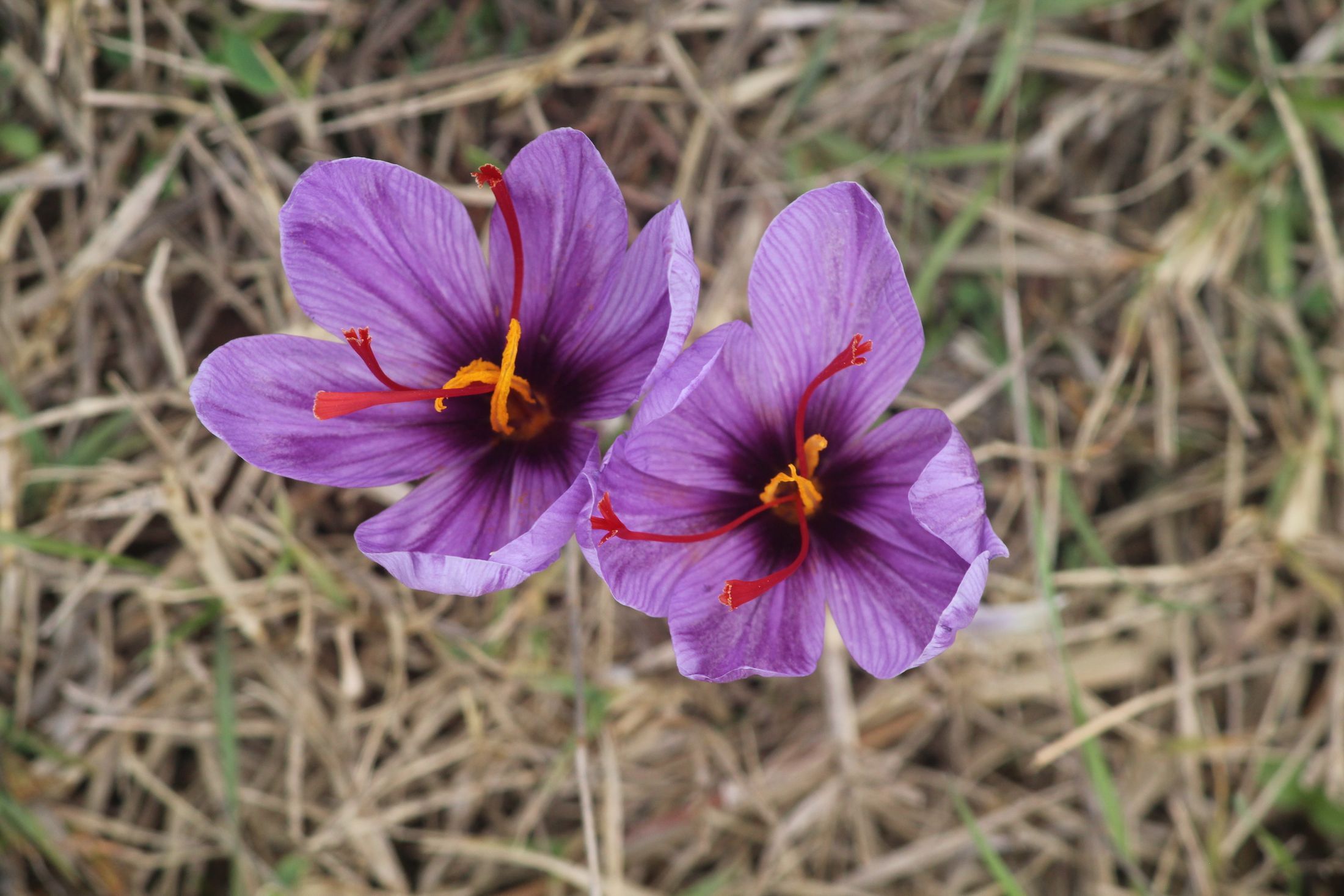
- GI No. 635 and the grade on the label. The pack should say Kashmir saffron, GI registration 635, and the grade: Mongra (all-red stigmas) or Lachha (stigma with some style). No grade stated usually means a blend.
- A harvest date. Kashmir harvests in October and November. A date within the last 12 to 18 months is fine; no date at all is a flag.
- A lot or batch code. It should be printed, not a sticker, and it should match a report you can see before you pay.
- A per-batch ISO 3632 report. Crocin of 200 or more, picrocrocin of 70 or more, safranal between 20 and 50, moisture under 12 percent, and “artificial colourants: not detected”. See the next section for what the document should look like.
- Whole threads, all red, with trumpet tips. Not powder, not yellow-tipped, not uniformly cut. Powder can be anything.
- A price that passes the sanity test. Under about $12, £10 or AED 45 per gram for a 1 g pack labelled Kashmiri is hard to square with wholesale at the Pampore auction. Under $8 per gram for any saffron is the trade’s own warning line. Our full price analysis is in saffron price per gram in 2026.
- Shipping and refund terms in writing. Tracked courier, who pays duties, and what happens if the saffron fails a test. Our answer to the last one is a double-money-back purity guarantee.
What a lot code and lab report should look like
A lot code is simply a short identifier, often the harvest year, village or grower initials and a batch number, printed on the label and ideally encoded in a QR code. Its only job is to connect your vial to one specific test. On our vials the lot code sits next to the crocin number, the harvest date and the grower’s name; type it into our verify page and you get the full report for that batch.
The report itself should come from an accredited laboratory. In India that means NABL accreditation, and a NABL report carries a ULR (Unique Laboratory Report) number that can be checked on the QCI portal, as described in a guide to verifying saffron lab reports. The report should show:
- The lab’s name and NABL accreditation number
- The batch code, matching the pack
- The report date and ULR number
- Crocin (colouring strength at 440 nm), picrocrocin (bitterness at 257 nm) and safranal (aroma at 330 nm), with the ISO 3632 category
- Moisture and floral waste percentages
- A test for artificial colourants, which should read “not detected”
Red flags are a missing ULR, a batch number that does not match the pack, a pixelated or edited PDF, a “certificate” with no actual values, and a lab whose accreditation has lapsed. Indian food-safety labs flagged a 22 percent rise in saffron samples adulterated with safflower, corn silk or synthetic dyes in the first quarter of 2026, so the paperwork is doing real work. For what to do once the vial arrives, see how to spot fake saffron.
Timing your order: Ramadan, Nowruz, Diwali and Christmas
Saffron demand has four peaks, and three of them fall within six months of the Kashmir harvest.
- Diwali (October or November). The first fresh-crop saffron of the year is drying in Pampore as Diwali approaches. It is the natural gift for Indian households abroad, for kheer, halwa and sweets. Order two to three weeks ahead; new lots sell out quickly in a short-crop year.
- Christmas (December). Searches for “saffron threads” peak in October and December for holiday cooking and gifting, and Sweden alone bakes its way through at least 10 tonnes of saffron for Lucia buns. A 1 g or 2 g vial with the lab number on it is a gift that explains itself.
- Ramadan (mid-February to mid-March in 2027). Ramadan is the peak saffron consumption period in Muslim-majority countries, for saffron milk, rice and desserts at iftar. Gulf and UK buyers should order before the month begins.
- Nowruz (20 March). Persian and Afghan households buy saffron for the new-year table alongside nuts and sweets. Kashmiri Mongra is a serious gift for a family that knows its saffron.
Whatever the occasion, buy whole threads in glass, keep them sealed and away from light, and the saffron will be as good at the next festival as it was at the last one.
Read next: Kashmir saffron GI tag explained and How to spot fake saffron: seven tests you can do at home.
Questions people ask
Where can I buy genuine Kashmiri saffron online?
The safest source is a seller who buys at origin in Pampore and can show a per-batch ISO 3632 lab report, a lot code and the GI number 635 on the pack. Two established US spice brands sell Kashmiri saffron at $18 to $21 per gram without published batch numbers. Marketplaces and grocers are convenient but carry the highest risk of Iranian saffron relabelled as Kashmiri. Whatever the channel, check the lot code and report before paying.
What is the Kashmiri saffron price in the UAE?
Genuine GI-tagged Kashmiri Mongra sold direct from Srinagar to the UAE costs about AED 73 per gram, with 2 g at AED 132, 5 g at AED 290 and 10 g at AED 530, duties included. Dubai is the world's largest buyer of Iranian saffron, so much of what is sold locally as Kashmiri is Iranian super negin at a lower price. If a Kashmiri label is priced like Iranian saffron, ask for the lab report.
Can I buy Kashmiri saffron in the USA without paying import duties?
Only if the seller prepays them. The US ended duty-free treatment for low-value parcels on 29 August 2025 and added tariffs on Indian-origin goods, and India Post suspended ordinary parcel service to the US. Sellers still shipping by post may see parcels delayed or returned. We ship by tracked express courier with US duties handled at checkout, so the price shown is the price you pay at the door.
Is Kashmiri saffron sold in UK supermarkets?
Not usually. UK supermarket saffron is almost all Spanish or Iranian, priced at about £3 to £3.25 for a 1 g pack or £8 to £12 per gram in 0.4 g sachets. Kashmiri saffron in the UK comes from online sellers, Indian grocers and a few specialist importers, typically at £15 to £19 per gram. We ship 1 g vials to the UK for £16.99 with duties and VAT handled.
How do I know a Kashmiri saffron lab report is real?
A genuine report comes from a NABL-accredited Indian lab, carries a ULR number you can verify on the QCI portal, names a batch code that matches the one printed on your pack, and lists crocin, picrocrocin and safranal with moisture and a check for artificial colourants. A generic certificate with no batch code, no ULR, or a blurry PDF is not proof of anything. Our reports are searchable by lot code on our verify page.
When should I order saffron for Ramadan, Diwali or Christmas gifts?
Order at least two to three weeks before the date. Kashmir's harvest is in October and November, so fresh-crop saffron lands just in time for Diwali and Christmas. Ramadan is the peak saffron season in the Gulf and runs from roughly mid-February to mid-March in 2027, and Nowruz falls on 20 March. Courier transit from Srinagar varies by country, so check current estimates before a deadline.
Written by the Kashmiri Treasures team in Srinagar. We buy at the field in Pampore, test every lot to ISO 3632, and print the result on the vial. See who we are or verify a lot.