How to Use Saffron: Blooming, How Much per Dish, and 12 Ways to Cook With It
How to use saffron properly: bloom it first, dose it by dish with our threads-per-serving table, choose threads over powder and store it for years.
By Kashmiri Treasures · October 7, 2026 · 10 min read
Most people who buy good saffron for the first time use it wrong, and then wonder what the fuss is about. The threads go into a hot pan dry, the dish comes out faintly yellow with a few red specks, and the vial sits in a cupboard for a year.
The fix is simple. Saffron needs to be bloomed, which means steeped in a little warm liquid before it goes into the pot, and it needs to be measured in threads rather than guessed. Get those two things right and a single gram of Kashmiri Mongra will carry you through forty or fifty dishes.
This guide covers how to bloom saffron three ways, how much saffron to use per dish with a threads-per-serving table, when to add it, how to store it, the mistakes we see most often, and twelve practical ways to cook with it across Persian, Indian, Italian, Spanish, Swedish, Moroccan, Middle Eastern and modern kitchens.
Why blooming saffron matters
Saffron’s three working compounds behave differently in the pan, and that is the whole reason blooming exists.
Crocin is the colour. It is a water-soluble carotenoid, which means it dissolves readily in water, milk or stock but barely at all in oil. Drop dry threads into hot butter and most of the crocin stays trapped inside the stigma.
Safranal is the aroma, that hay-and-honey smell. It is volatile, so it evaporates quickly with heat and time. Rolling boils and long simmers send it out of the kitchen window.
Picrocrocin is the bitterness. It is what makes saffron taste like something rather than just look pretty, and too much of it is the reason over-saffroned dishes taste medicinal.
Blooming is the technique that respects all three: a small amount of warm liquid dissolves the crocin and picrocrocin evenly, while keeping the temperature low enough that the safranal survives. It is the single biggest difference between saffron that disappears into a dish and saffron that defines it. If you want the chemistry in more depth, our piece on ISO 3632 grades explains how labs measure each compound.
How to bloom saffron: three methods
Whichever method you choose, start by counting threads rather than pinching blindly. A 1 g vial holds roughly 150 to 180 threads, so 15 to 20 threads is about an eighth of a vial.
Method 1: warm water or stock
Place the threads in a small cup. Add 2 to 3 tablespoons (30 to 45 ml) of hot but not boiling liquid, around 60 to 70 °C (140 to 160 °F), roughly the temperature of water from a kettle that has sat for three or four minutes. Cover and leave for 15 to 20 minutes. The liquid will turn deep golden and the threads will swell. Add the liquid and the threads to the dish together.
This is the default for rice, risotto, paella, stews and sauces, and it works equally well with chicken or vegetable stock.
Method 2: warm milk
Use the same quantities, but with milk warmed to just below a simmer. Milk’s fat carries aroma well, so this is the method for biryani, kheer, saffron milk, custards and ice cream bases. Leave it for 20 minutes or, for biryani, up to an hour. Because milk is not acidic, the colour stays bright rather than drifting orange.
Method 3: grinding with sugar or salt
Put the threads in a small mortar with a pinch of granulated sugar (for sweet dishes) or coarse salt (for savoury). Grind to a fine orange powder. The crystals act as an abrasive and the powder dissolves almost instantly in a tablespoon of warm liquid, so this method is ideal when you are short on time, or for baking, where you want the saffron fully dispersed in dough. Persian cooks keep a small jar of this ground mix ready.
How much saffron to use: dosing by dish
The honest answer to “how much saffron to use” is: fewer threads than most recipes say, provided the saffron is good. Category I saffron with a crocin number above 200 goes a long way, and Kashmiri Mongra, which typically tests well above that, goes further still.
The table below is what we use at home with our own vials. Counts are per serving; multiply for the number of people.
| Dish | Threads per serving | Bloom in | When to add |
|---|---|---|---|
| Plain saffron rice or pilaf | 4–5 | Warm water or stock | With the cooking liquid |
| Biryani | 5–8 | Warm milk | Drizzled over the layers before dum |
| Kashmiri kahwa | 6–8 per cup | Warm water | Off the heat, after the tea |
| Risotto alla Milanese | 5–6 | Hot stock | Half midway, half at the end |
| Paella | 4–6 | Warm stock | With the stock |
| Desserts (kheer, panna cotta, ice cream) | 3–5 | Warm milk or cream | Into the warm base |
| Saffron milk | 4–6 per cup | Warm milk | Steep 10 minutes, then drink |
| Baking (buns, cakes) | 0.5 g per batch of 20–24 buns | Ground, then warm milk | Into the liquid for the dough |
| Savoury sauces (beurre blanc, fish stew) | 3–4 | Warm stock or wine | Last 5 minutes |
A useful rule: a generous pinch is about 20 threads, which is enough for a four-person rice dish, a six-cup pot of kahwa, or a batch of risotto. Your 1 g vial is therefore 7 to 9 such pinches.
Saffron threads vs powder
This question comes up constantly, so here is the plain version.
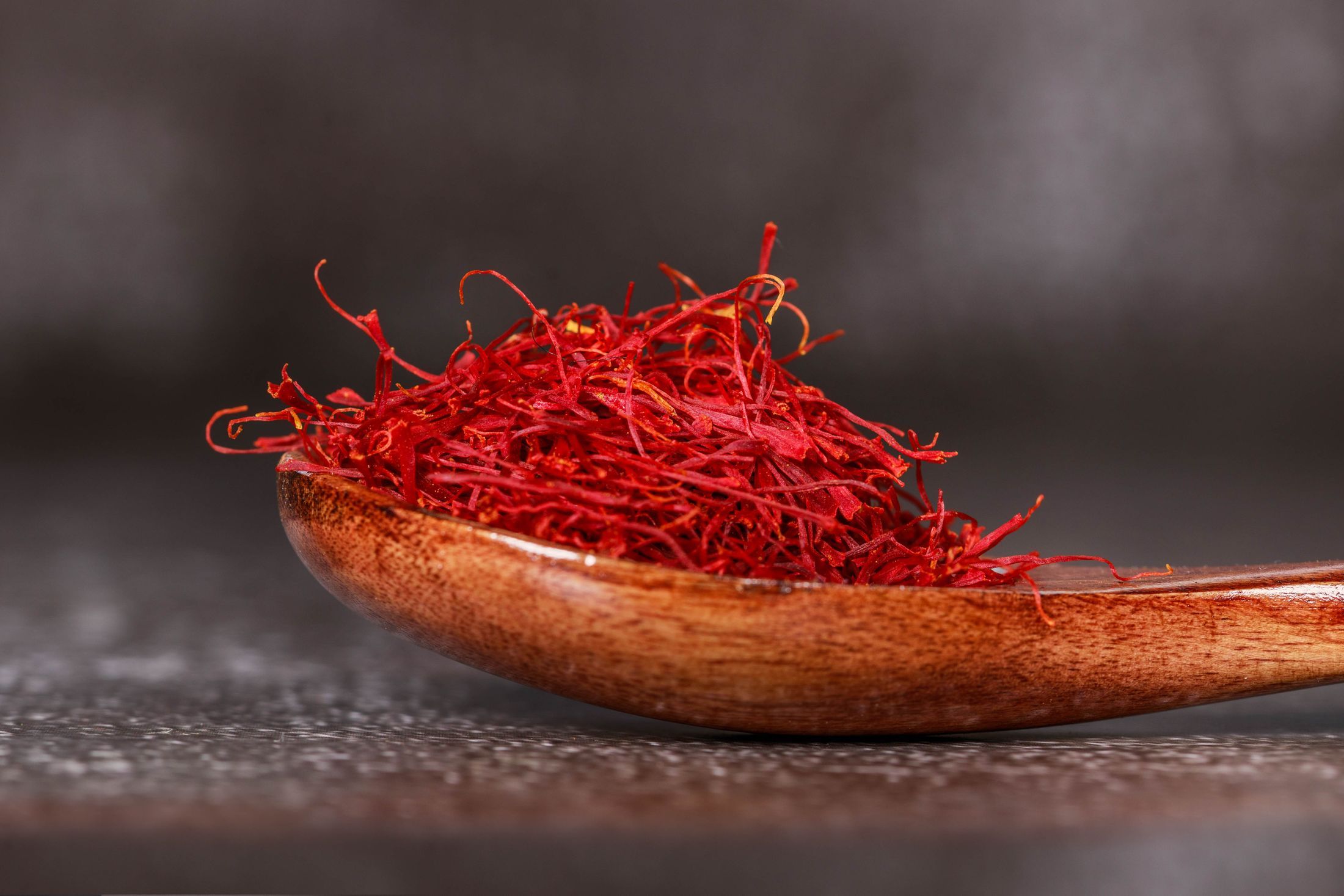
Threads are the whole dried stigma. You can see what you are buying: the trumpet-shaped tip, the deep red colour, the absence of yellow style. You can run a water test. They hold their aroma for years because the surface area exposed to air is small. The cost is a 15-minute bloom.
Powder is convenient and dissolves instantly, which is why Spanish and Swedish home cooks like it. The problem is trust. Powder is the easiest form of saffron to stretch with turmeric, paprika, safflower or ground style, and the only way to know is a lab test. Powder also loses safranal faster.
Our advice is to buy threads and grind them yourself when a recipe needs powder. Thirty seconds in a mortar with a pinch of sugar gives you fresh powder from saffron whose origin you can check, and every vial we sell carries the lot code and crocin number of its batch so you can look up the report on our verify page.
Timing: early for colour, late for aroma
Because crocin is stable and safranal is not, when you add the bloom changes what you get.
Add the bloomed saffron early, with the cooking liquid, when you want an even, deep colour all the way through: pilaf, paella, a slow fish stew. You will lose some aroma to the steam, but the colour will be uniform.
Add it late, in the last five minutes or off the heat, when aroma is the point: risotto, kahwa, saffron milk, sauces finished with butter. The colour will be slightly less even, which is why biryani cooks drizzle rather than stir, and why that marbled look is a feature.
For dishes where you want both, split the bloom. Half goes in at the start and half at the end. This is what we do for risotto alla Milanese and for Persian rice.
How to store saffron
Saffron is a dried flower part, and its enemies are the same as any dried herb: light, air, heat and moisture.
- Sealed glass, not plastic. Plastic is slightly permeable and can pick up the aroma. A small jar with a tight lid, or the vial it came in, is ideal.
- Dark. Light degrades crocin. Keep it in a cupboard, not on a shelf by the window, and never in a clear jar on display.
- Cool and dry. Room temperature in a cupboard is fine. The fridge is not better: condensation when you take it out introduces moisture, and moisture is what turns threads soft and dull.
- Whole, not ground. Grind only what you need, just before use.
Stored like this, good saffron keeps its colouring strength for two to three years. Aroma is at its peak in the first year after harvest, which is why we print the harvest date on every vial, so you can see how fresh the threads are rather than guessing.
Bloomed saffron liquid keeps for a day or two in the fridge, covered. Beyond that it loses aroma and is best discarded.
Common saffron mistakes
Adding it dry. The most common error. Dry threads in oil or on top of rice give you red specks and very little colour or flavour. Bloom first, always.
Boiling it. A rolling boil drives off safranal. Bloom in hot-not-boiling liquid, and when you add the bloom to a pot, do it after the hard boiling is done.
Using too much. More is not better. Beyond about 6 threads per serving in a savoury dish, picrocrocin bitterness takes over and the dish tastes of medicine. If a recipe calls for “a teaspoon” of threads, that is 60 or more, and it was written for weak saffron.
Grinding in a plastic grinder. The threads stick and you lose half. Use a small ceramic or stone mortar with sugar or salt.
Judging by colour alone. Turmeric turns rice yellow too. Saffron’s job is aroma and the particular honeyed bitterness. If you only want yellow, use turmeric.
Buying blind. If a vial has no lab number, no harvest date and no origin, the problem may not be your cooking.
12 ways to use saffron
Here are twelve things to actually cook, each with a thread count for four servings unless stated.
-
Persian chelow with tahdig. Parboiled basmati steamed over a crisp saffron crust. Bloom 20 threads with a pinch of sugar in 3 tablespoons (45 ml) hot water; mix a third into the bottom layer and pour the rest over the top before serving.
-
Biryani saffron milk. Steep 25 to 30 threads in 60 ml (¼ cup) warm milk for 30 minutes and drizzle over the top layer of rice before sealing the pot. Do not stir; the streaks are the point.
-
Kashmiri kahwa. Green tea with cardamom, cinnamon and crushed almonds, finished with 6 to 8 threads per cup added off the heat. Quantities for two and six cups are in the recipe linked at the end of this article.
-
Risotto alla Milanese. Bloom 20 to 25 threads in 3 tablespoons (45 ml) hot stock. Add half at the ten-minute mark and the rest with the butter and Parmigiano at the end. Serve with osso buco or on its own.
-
Paella or arroz a banda. Bloom 20 threads in a ladle of warm fish or chicken stock and add with the rest of the stock. Do not stir after this point; saffron and socarrat both reward patience.
-
Swedish lussekatter. Saint Lucia saffron buns for 13 December. Grind 0.5 g (roughly 80 threads, half a vial) with 1 tablespoon sugar and dissolve in 250 ml (1 cup) warm milk for a dough of about 500 g (4 cups) flour. The buns should be sunshine yellow all the way through, which only happens if the saffron is fully dissolved before kneading.
-
Moroccan chicken tagine with preserved lemon. Bloom 15 threads in 2 tablespoons (30 ml) warm water and add with the onions, ginger and turmeric at the start. The long braise draws the colour into the sauce; add a few more bloomed threads in the last five minutes for aroma.
-
Middle Eastern saffron rice with barberries or raisins. Cook plain basmati, then fold through 2 tablespoons (30 ml) of a 15-thread bloom and a handful of barberries softened in butter and a pinch of sugar.
-
Saffron milk. Warm 250 ml (1 cup) milk to a steam, add 5 threads, a pinch of ground cardamom and a teaspoon of honey, and let it sit for 10 minutes. The simplest way to taste what good saffron actually tastes like.
-
Saffron panna cotta or custard. Bloom 12 to 15 threads in the warm cream before adding the gelatine or eggs. Pairs with poached pears, pistachio and honey.
-
Saffron and cardamom ice cream. Infuse 20 threads in the milk-and-cream base over low heat with 4 crushed cardamom pods. Strain or leave the threads in for visual effect. Kulfi follows the same logic with condensed milk.
-
Saffron beurre blanc or aioli for fish. For a sauce serving four, bloom 10 to 12 threads in 1 tablespoon (15 ml) warm white wine or stock and whisk into the sauce at the end. A few threads in an aioli for grilled prawns or bouillabaisse works the same way.
A note on which saffron to use
Everything above assumes genuine, reasonably fresh saffron. Weak threads need double the dose, and adulterated ones never deliver regardless of technique. We grow and pack Kashmiri Mongra from Pampore, which is the stigma-only grade, and each batch is lab-tested to ISO 3632 Category I before it is bottled. Our current lot, KT25A, tested at a crocin reading of 248, well above the Category I threshold of 200, and that number is printed on the vial alongside the harvest date and the grower’s name.
Read next: Kashmiri Kahwa Recipe: The Traditional Saffron Green Tea, Step by Step and Saffron Rice, Three Ways.
Questions people ask
How much saffron should I use per person?
For most savoury dishes, 4 to 6 threads per serving is plenty, so a pinch of 15 to 20 threads colours and flavours a rice dish for four. Drinks such as kahwa or saffron milk take 6 to 8 threads per cup. Desserts need less, about 3 to 5 threads per portion, because sugar and dairy carry the aroma well. If your saffron is strong, such as Kashmiri Mongra with a crocin reading above 230, start at the lower end.
Do I really have to bloom saffron before cooking?
Yes, if you want the colour and flavour you paid for. The colour compound, crocin, dissolves in water, not in oil, and dry threads dropped straight into a pan release very little of it. Steeping threads in a few tablespoons of warm water, milk or stock for 15 to 20 minutes draws the colour and aroma out so it spreads evenly through the whole dish instead of staying locked inside a few threads.
Is saffron powder as good as saffron threads?
Powder is convenient and does not need blooming, but it is much easier to adulterate with turmeric, paprika or ground safflower, and it loses aroma faster because safranal evaporates from the larger surface area. Threads let you inspect the stigma shape and colour, run a water test, and keep for years. If you need powder for baking, grind whole threads yourself just before use with a pinch of sugar in a mortar.
What is the best way to store saffron?
Keep threads in a sealed glass container, away from light, heat and moisture, in a cupboard rather than the fridge. Light bleaches crocin and air carries off the volatile aroma, so avoid plastic bags and clear jars on a windowsill. Stored this way, good saffron keeps its colouring strength for two to three years, though the aroma is at its best in the first year after harvest. Never store bloomed liquid for more than a day or two.
Can you add too much saffron?
Yes. Saffron contains picrocrocin, the compound that gives it its characteristic bitterness, and beyond a certain point a dish turns medicinal and slightly metallic rather than fragrant. Doubling the amount does not double the pleasure. If you have overdone it, dilute with more of the base ingredient, add a little acid or sweetness, and use less next time. With Category I saffron, 20 threads is a generous amount for a dish serving four.
Written by the Kashmiri Treasures team in Srinagar. We buy at the field in Pampore, test every lot to ISO 3632, and print the result on the vial. See who we are or verify a lot.